


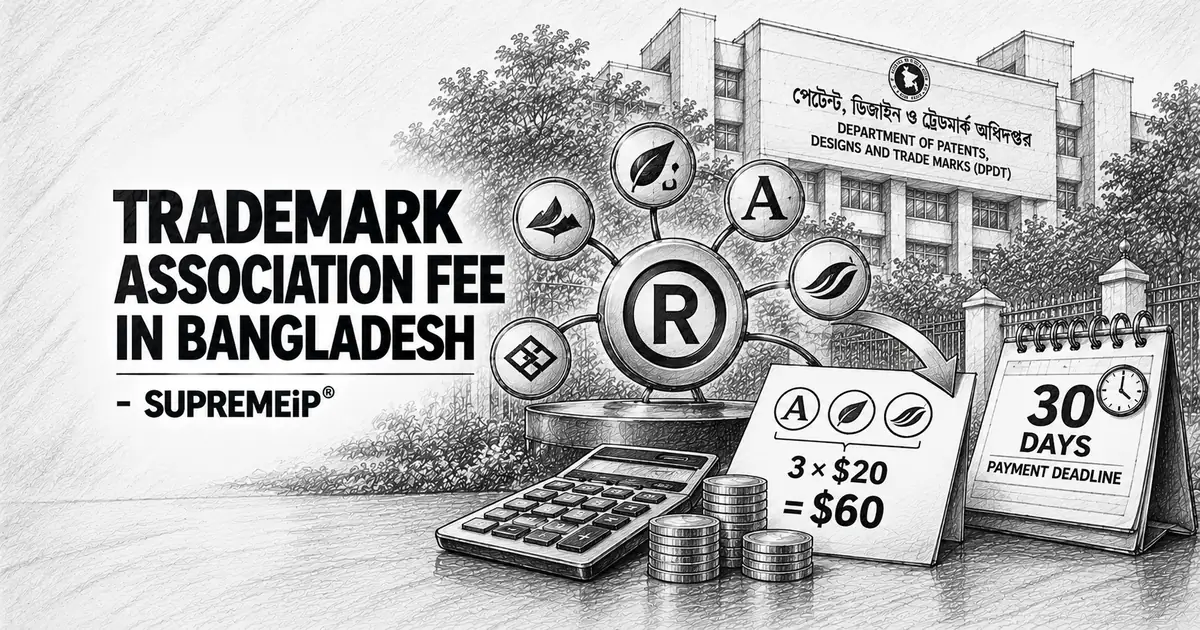
Trademark Association Fee in Bangladesh
Trademark Association Fee in Bangladesh: What It Is and How It Works
Learn what the association fee in Bangladesh is, when the DPDT charges it, how the trademark citation fee is calculated, and what happens if you miss the 30-day deadline.
The Department of Patents, Designs and Trademarks (DPDT) administers trademark registration in Bangladesh under the Trademarks Act, 2009. Most fees are clear at filing. The trademark association fee in Bangladesh is the exception, because it appears only after your mark is accepted.
This guide explains the fee in a fixed order: what it is, when it applies, how it is counted, when it is due, and how to plan for it. It also answers the questions owners ask most.
What Is the Association Fee in Bangladesh?
When one owner holds several similar marks in the same class, the DPDT may link them on the register and charge for it. That charge is the association fee. It is also called a trademark citation fee, because each earlier mark the DPDT links to your new one is “cited”.
A Fee for Linking Marks
The DPDT charges USD 20 for every earlier mark it cites against your new application. The new mark and the cited marks must all belong to you.
The Earlier Mark Being Linked
A cited mark is one of your own earlier marks that the DPDT finds similar to the new one in name, logo, design or overall look.
Owners of Several Related Marks
Single-mark applicants rarely see this fee. It mostly affects brand families, sub-brands, logo variants and re-filed versions of one brand.
The link shows that similar marks come from one source. It tells the DPDT and the public that the marks belong to one brand family, not to rival businesses.
When the DPDT Association Fee Applies to Similar Trademarks in Bangladesh
The fee does not follow every filing. The DPDT looks for a specific set of conditions before it issues a demand.
| Condition | What the DPDT looks at |
|---|---|
| Same owner | The earlier and new marks must stand in the name of the same individual or company. |
| Same class | Both marks must be registered or pending in the same trademark class. |
| Similarity | The marks must be alike in name, logo, design or overall commercial look. |
| Accepted status | The new application must already be accepted, with the registration fee paid. |
| DPDT selection | Not every similar mark is cited. The DPDT decides which earlier marks it links. |
Two marks need not be identical. A small change to a word, colour or logo can still leave them close enough to be linked.
Why the Trademark Citation Fee Comes After Acceptance
Most fees in the process are known at filing. This one is not. The DPDT checks for linked marks only at the end, so the demand arrives late.
Filing
You file the application and pay the standard fee. No portfolio comparison happens yet.
Examination
The examiner reviews the mark. The association question is not raised here.
Acceptance and Publication
The mark is accepted and published. Still no association fee appears.
Registration Fee Payment
You pay the registration fee to move towards the certificate.
Association Check and Demand
Only now does the DPDT compare the mark with your other marks and, if it finds links, issue the demand.
Because the check happens last, neither you nor your agent can know the final amount in advance. We can only flag the risk from your portfolio.
DPDT Association Fee in Bangladesh: How It Is Calculated
The rate is fixed. The total depends only on how many of your earlier marks the DPDT cites.
Total fee = USD 20 × number of cited marks. The DPDT, not the applicant, decides the number.
| Cited marks | Total association fee |
|---|---|
| 1 | USD 20 |
| 2 | USD 40 |
| 3 | USD 60 |
| 5 | USD 100 |
| 10 | USD 200 |
Owning ten similar marks does not mean ten are cited. The DPDT may cite fewer, so the bill can be lower or higher than you expect.
30-Day Deadline and What Happens If You Do Not Pay
The demand notice starts a short clock. Act on it the day it arrives.
30 Days from the Notice
Payment is due within 30 days of the demand notice. Counting starts from the notice date, not from when you first read it.
Application May Be Rejected
If the fee stays unpaid, the DPDT may reject the application, even though the mark was already accepted.
Earlier Spending Is at Stake
Filing, examination and registration costs buy you nothing if the application falls at this last step.
The Mark Is Unprotected Again
A rejected application leaves the mark without registration, so you would need to file again.
Send the notice to your agent the same day. Confirm the number of cited marks, then arrange payment well before day 30.
Association Fee vs Trademark Registration Fee
People often read the demand as a second registration fee. The two charges serve different purposes.
| Point | Registration fee | Association fee |
|---|---|---|
| Purpose | Registers the accepted mark | Links the mark to your similar earlier marks |
| Known at filing | Yes | No |
| Charged for | Each application | Each cited mark |
| Always payable | Yes | Only if the DPDT cites marks |
| Stage | After acceptance | After the registration fee is paid |
Why Associated Marks Matter for Brand Owners
The fee is a cost, but the link it creates has practical uses.
A Clear Record of Ownership
The register shows your related marks as one family. That helps in disputes and in showing a brand was built over time.
Easier Portfolio Review
Buyers, investors and licensees can see at a glance which marks belong together.
Room for Sub-Brands
You can add variants and extensions while keeping them tied to the core mark.
How to Plan for Trademark Class Fees and Association Costs in Bangladesh
A little preparation removes most of the surprise. Four habits help.
List every mark you own by class, with filing dates and status.
Set aside a small reserve per related filing for possible cited-mark charges.
Tell your agent about earlier similar marks before you file a new one.
Pick the class that fits what you sell. Moving a mark to another class only to avoid this fee can leave real goods unprotected.
Common Mistakes with Association Fee Notices
Most problems come from delay or from misreading the notice.
Waiting Until Day 25
Bank transfers and approvals take time. Late payment has the same result as no payment.
Treating It as a Scam
Because the demand is unexpected, some owners ignore it. Check it with your agent first.
Not Counting Cited Marks
Check the list of cited marks in the notice against your own records.
Using Old Contact Details
A notice sent to an outdated address may reach you late. Keep your agent and address details current.
Conclusion
The trademark association fee in Bangladesh is a small, fixed charge of USD 20 per cited mark. The risk lies in its timing and its deadline. It appears only after acceptance, and it must be paid within 30 days.
Owners of related marks should keep a portfolio list, hold a small reserve and pass every DPDT notice to their agent at once. With those three steps the fee stays a minor cost, not a threat to your registration.
Frequently Asked Questions on Trademark Association Fee in Bangladesh
Q01What is the trademark association fee in Bangladesh?
It is a fee of USD 20 per cited mark, charged by the DPDT when your new mark is similar to your own earlier marks in the same class.
Q02What does a cited mark mean?
A cited mark is an earlier mark of yours that the DPDT links to the new application because the two are similar.
Q03Is the trademark citation fee the same as the association fee?
Yes. Both names describe the same USD 20 per cited mark charge.
Q04When does the DPDT ask for the association fee?
After the mark is accepted and the registration fee is paid. It is the last charge before registration.
Q05Why is the fee not shown at filing?
The DPDT compares your marks only at the end of the process, so the amount is unknown until the demand notice arrives.
Q06How much will I pay for three cited marks?
Three cited marks cost USD 60 (3 × USD 20).
Q07What is the payment deadline?
You must pay within 30 days of the date of the demand notice.
Q08What happens if I miss the 30-day deadline?
The DPDT may reject the application, and the mark would not be registered.
Q09Does every similar mark trigger the fee?
No. The DPDT chooses which earlier marks to cite, so some similar marks may not be linked.
Q10Do the marks need to be in the same class?
Yes. The fee concerns similar marks you own in the same class.
Q11Do the marks need the same owner?
Yes. The linked marks must stand in the same owner's name.
Q12Can I find out the fee before I file?
No. We can assess the risk from your portfolio, but only the DPDT can confirm the number of cited marks.
Q13Is the association fee part of the registration fee?
No. It is a separate charge, payable only if the DPDT cites earlier marks.
Q14Should I file in another class to avoid the fee?
No. Choose the class that matches your goods or services. A wrong class can leave your products unprotected.
Q15How does SUPREMEiP Law Firm handle association fee notices?
We review the notice, check the cited marks against your records, confirm the amount and arrange payment well before the 30-day deadline.


