


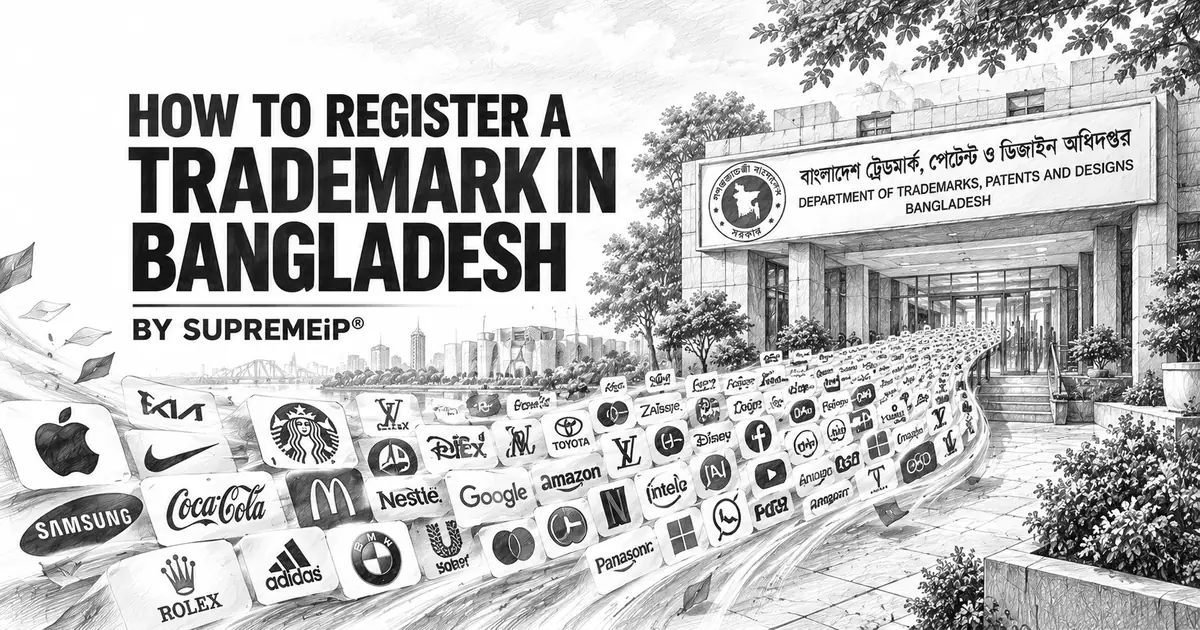
Trademark in Bangladesh
How to Register a Trademark in Bangladesh?
Complete Guide to Trademark Registration in Bangladesh — For Domestic & Foreign Applicants
What Is a Trademark and Why Does It Matter?
A trademark is any distinctive word, symbol, phrase, logo, or combination that sets your goods or services apart from competitors. In Bangladesh, your trademark is a powerful legal tool — it gives you the exclusive right to use your brand identity and prevents others from copying or misusing it. Protecting your brand through Trademark Bangladesh registration is the first step toward building a secure business presence.
Trademarks in Bangladesh are governed by the Department of Patents, Designs and Trademarks (DPDT), operating under the Ministry of Industries. The principal laws are the Trademarks Act, 2009 and the Trademark Rules, 2015.
What Can Be Registered as a Trademark?
- →Brand names and words
- →Logos and device marks
- →Slogans and taglines
- →Combination marks (word + logo)
- →Colour combinations (when used as a mark)
A mark will be refused if it is identical or deceptively similar to an existing registered mark; descriptive or generic; contrary to public morality or law; or likely to deceive or cause confusion.
Who Can Apply for Trademark Registration in Bangladesh?
Bangladeshi individuals or businesses may apply directly at the DPDT online portal.
Must appoint a local trademark agent or law firm to represent them throughout the entire process.
Trademark Bangladesh: Complete Registration Process & Stage Chart
Total timeline: 7–18 months · Total official cost: approx. USD $356
- ·Search the DPDT online database for identical or similar marks
- ·Bangladesh uses the NICE International Classification
- ·Reduces risk of objections and saves time and money
- ·Applicant's full name, address, and nationality
- ·Trademark name or logo (JPEG format for logo marks)
- ·Class of goods/services under NICE Classification
- ·Power of Attorney (scanned copy; no notarization required)
- ·Priority claim details (if claiming Paris Convention priority)
- ·English translation if the mark contains non-English text
- ·Foreign applicants must appoint a local agent before filing
Ordinary Application — protection within Bangladesh only. Convention Priority Application — filed under Paris Convention within 6 months, backdated to foreign filing date.
- ·Registrar reviews distinctiveness and capability for registration
- ·DPDT checks for conflicts with existing registered or pending marks
- ·Outcome: Acceptance, Objection, or Rejection
- ·If objected, applicant must respond within two months
Submit a counter-statement with supporting arguments within 2 months. Engaging an IP lawyer significantly improves your chances of success.
- ·DPDT sends a TMR-05 notice indicating the publication fee amount
- ·Pay the publication fee within one month of receiving TMR-05
- ·Submit Form TMR-09 along with the payment
- ·Trademark published in the official Bangladesh Trademarks Journal
Failure to pay the publication fee on time may result in stalling or rejection of your entire application.
- ·Any person may file opposition within 2 months of journal publication
- ·No extensions permitted — deadline strictly enforced
- ·If opposed, submit counter-statement within 2 months or application is abandoned
- ·If no opposition, mark proceeds directly to registration
- ·Registrar enters the trademark in the official Register
- ·Registration backdated to original filing date (or priority date)
- ·Certificate of Registration issued under seal of the Registry
- ·Initial registration valid for 7 years from the registration date
- ·Apply before the expiry of the current registration period
- ·After initial 7-year term, each renewal covers 10 years
- ·No limit — trademark can remain protected indefinitely
- ·Removed trademark can be restored within 1 year of removal
Official Cost Summary
| Stage | Timeline | Fee (USD) |
|---|---|---|
| Pre-Step: Trademark Search | 2–20 working days | $27 |
| Stage 1: Filing Application | 1–2 working days | $76 |
| Stage 1A: Examination | 3–6 months | Free |
| Stage 2: Publication | 2–5 months | $37 |
| Stage 2A: Opposition Period | 2 months (max 5) | Free |
| Stage 3: Registration | 1–4 months | $243 |
| TOTAL OFFICIAL COST | ≈ $356 | |
Trademark Renewal in Bangladesh — Validity & Key Dates
Under Section 22 of the Trademarks Act 2009, a registered trademark is initially protected for 7 years — an unusual term compared to many countries which start at 10 years. Trademark renewal in Bangladesh is therefore critical to track carefully from the filing or priority date to avoid losing your exclusive rights.
(from filing / priority date)
(renewable indefinitely)
The certificate issuance date is NOT the registration date. Your 7-year protection runs from the filing date or priority date — not from when the certificate was printed.
Under Section 20 of the Trademarks Act 2009, the "Registration Date" is defined as follows:
- →If priority is claimed: the priority date (i.e., the date of the original foreign application filed under the Paris Convention) is treated as the official Registration Date in Bangladesh.
- →If no priority is claimed: the filing date of the Bangladesh application is treated as the official Registration Date.
In simple terms, the Registration Date = Filing Date or Priority Date, whichever is earlier. Always calculate your 7-year protection period and renewal deadline from this date — never from the date printed on your Registration Certificate.
Rights Granted by Trademark Registration in Bangladesh
Exclusive right to use the mark for the registered class(es) across Bangladesh.
Right to file suit in the District Court against anyone using a deceptively similar mark.
Courts can grant injunctions, award damages, and order destruction of infringing goods.
Can be assigned, licensed, or used as collateral — real commercial value beyond legal protection.
Registration is prima facie evidence of ownership. After 7 years, validity becomes conclusive.
Right to request Customs to seize goods bearing false trademarks on importation.
Trademark Bangladesh for Foreign Businesses — What You Must Know
Bangladesh is a member of both the Paris Convention and the WTO. This means:
- →Paris Convention priority can be claimed if you file within 6 months of your original foreign application
- →All foreign applicants must appoint a local trademark agent or law firm
- →Power of Attorney required — notarization not needed; scanned signed copy is sufficient
- →If your mark contains non-English text, an English translation must be provided
Trademark Registration in Bangladesh: How to Respond to an Objection (Office Action)
How to Respond to a Trademark Objection
The applicant has 60 days from receipt of the examination report to file a reply with supporting documents. The Registrar may accept the application based on the reply or schedule a hearing. If the applicant is unsatisfied with the Registrar's decision, an appeal can be filed within 1 month requiring the Registrar to state grounds for his decision in writing. Engaging an experienced IP lawyer significantly improves your chances of success.
For any objections, strategic approaches — such as directly applying for a hearing or challenging the cited mark's validity (e.g., on grounds of abandonment) — can accelerate resolution considerably.
No Invented Word
The mark lacks an invented (coined) word with no direct meaning in any language. Marks like "KODAK" or "PEPSI" were coined solely for branding. Common words used as marks face this objection. Solution: Choose a unique coined word that does not directly describe your goods or services.
Absolute Grounds for Refusal
Section 8 lists several absolute grounds for refusal — marks that are non-distinctive, descriptive, deceptive, contrary to morality or law, or likely to cause confusion among the public.
Descriptive or Generic Mark
Marks consisting of personal names, geographical names, names of sects/castes, or terms describing the character or quality of goods face objection. Example: "Dhaka" for rice or "Sweet" for candy would be refused. A coined variant like "Milko" for dairy may be allowed.
Similarity to an Earlier Registered Mark
This is the most common objection. The mark is identical or deceptively similar to an existing registered mark for the same or similar goods/services. A Section 10(3) objection creates an "absolute bar" — the application cannot proceed until the earlier mark is resolved.
Country of Origin Certificate
The DPDT may ask a foreign applicant to submit an attested copy of the Country of Origin Certificate — proof of the mark's registration or use abroad. Common when there is doubt about prior rights.
Translation & Transliteration Requirement
Marks containing words in a language other than English or Bengali require a notarized Translation and Transliteration Certificate. Only English and Bengali marks are permitted on the Bangladesh register. This should ideally be submitted at the time of filing to avoid delay.
Frequently Asked Questions — Trademark Bangladesh, Registration & Renewal
Click any question to expand the answer.
Q01How do I register a trademark in Bangladesh?▼
To register a trademark in Bangladesh, you must file an application with the Department of Patents, Designs and Trademarks (DPDT) under the Ministry of Industries. The process involves: (1) conducting a trademark search, (2) filing the application with the required documents, (3) examination by the Registrar, (4) responding to any objections within 60 days, (5) paying the publication fee, (6) publication in the Trademark Journal with a 2-month opposition window, and (7) issuance of the Registration Certificate. The entire process typically takes 7 to 18 months. Foreign applicants must appoint a local trademark agent or law firm.
Q02How long does trademark registration take in Bangladesh?▼
The total timeline is typically 7 to 18 months from filing to receipt of the Registration Certificate. A smooth application with no objection and no opposition can complete in approximately 7 months. If the DPDT raises an objection or a third party files opposition, the process can extend to 18 months or longer.
Q03What is the cost of trademark registration in Bangladesh?▼
The total official government fee for a single-class trademark application in Bangladesh is approximately USD $356, covering the filing fee, examination fee, and publication fee. This excludes professional legal fees charged by your trademark agent or law firm. Foreign applicants will also incur representation fees. For multiple classes, separate applications must be filed — each incurring its own set of official fees.
Q04What law governs trademark registration in Bangladesh?▼
Trademark registration and protection in Bangladesh are primarily governed by the Trademarks Act, 2009 and the Trademark Rules, 2015. The DPDT administers the registration process under the Ministry of Industries. Bangladesh is also a member of the Paris Convention and the WTO/TRIPS Agreement, which grants rights to foreign applicants including convention priority claims.
Q05What can be registered as a trademark in Bangladesh?▼
A trademark in Bangladesh can be any distinctive word, phrase, logo, symbol, design, shape, color combination, or any combination thereof that identifies and distinguishes the goods or services of one person from those of others. The mark must be capable of distinguishing — generic, descriptive, or purely common terms are generally not registrable without acquired distinctiveness.
Q06Who can apply for trademark registration in Bangladesh?▼
Any person — individual or company — claiming to be the proprietor of a trademark used or proposed to be used may apply for registration. Bangladeshi applicants may file directly through the DPDT online portal. Foreign applicants must appoint a local trademark agent or law firm to represent them. Both resident and non-resident applicants have equal rights to register trademarks in Bangladesh.
Q07Can a foreign company register a trademark in Bangladesh?▼
Yes. Foreign nationals and foreign companies have the same rights as Bangladeshi applicants to register trademarks in Bangladesh. However, they must appoint a local trademark agent or law firm — direct filing by foreign applicants is not permitted. A Power of Attorney is required; a scanned signed copy is sufficient (no notarization needed). If the mark contains non-English text, a Translation and Transliteration Certificate must also be provided.
Q08Is it mandatory to use a trademark attorney in Bangladesh?▼
It is not legally mandatory for Bangladeshi applicants, but it is strongly recommended for all applicants — local and foreign alike. For foreign applicants, appointing a local trademark agent is a legal requirement. An experienced IP attorney helps avoid procedural errors, drafts effective objection responses, monitors deadlines, and significantly improves the overall success rate of the application.
Q09Is a trademark search mandatory before filing in Bangladesh?▼
A trademark search is not legally mandatory, but it is strongly advisable. Conducting a clearance search — using Form TM-04 at the DPDT — helps determine whether your proposed mark is registrable, whether similar marks already exist, and can prevent costly objections and oppositions later. Bangladesh follows the NICE International Classification, and searches should cover the relevant class and associated classes.
Q10Can I file a trademark application for multiple classes in Bangladesh?▼
No. Bangladesh only allows single-class applications. If you need protection across multiple classes, you must file separate applications for each class. Bangladesh follows the NICE International Classification — Classes 1–34 cover goods and Classes 35–45 cover services. Each application incurs its own filing and prosecution fees.
Q11What documents are required to file a trademark application in Bangladesh?▼
The key documents required are: (1) a clear representation of the trademark, (2) a list of goods/services and the relevant NICE class, (3) the applicant's full name and address, (4) a Power of Attorney (for foreign applicants — scanned signed copy is sufficient), (5) a Translation and Transliteration Certificate (if the mark contains non-English/non-Bengali words), and (6) proof of prior foreign filing if claiming Paris Convention priority.
Q12What is a convention priority application for trademarks in Bangladesh?▼
A convention priority application allows an applicant who has already filed a trademark in a Paris Convention member country to file the same mark in Bangladesh within 6 months of the original foreign filing date, with the Bangladesh application backdated to that earlier date. This protects your international priority. After the 6-month window closes, the priority right is permanently lost.
Q13What happens after a trademark application is filed in Bangladesh?▼
After filing, the DPDT Registrar examines the application for distinctiveness, deceptiveness, and conflicts with existing registered marks. If no objection is raised, the application proceeds to publication in the Trademark Journal. If an objection is raised, the applicant receives an official examination report and must respond within 60 days. The examination stage typically takes 6 months to 1 year depending on the DPDT backlog.
Q14What are the common grounds for trademark objection in Bangladesh?▼
Common objection grounds include: Section 6 — lack of an invented word; Section 8 — absolute grounds such as non-distinctiveness, deceptiveness, or marks contrary to morality; Section 9 — descriptive or generic marks (personal names, geographic names); Section 10 — similarity to an earlier registered mark; Section 67 — requirement for a Country of Origin Certificate (for foreign marks); and Section 120 — requirement for a Translation and Transliteration Certificate (for non-English/Bengali marks).
Q15How do I respond to a trademark objection in Bangladesh?▼
Upon receiving an examination report, the applicant has 60 days to file a written reply addressing each ground of objection, supported by relevant documents and legal arguments. The Registrar will review the response and either accept the application, reject it, or schedule a hearing. If unsatisfied with the Registrar's decision, an appeal can be filed within 1 month, requesting the Registrar to provide written grounds for the decision. Engaging an experienced IP lawyer is strongly recommended for drafting effective objection responses.
Q16What is a Section 10(3) objection and how is it resolved?▼
A Section 10(3) objection is raised when the DPDT finds that a mark identical or deceptively similar to the applied mark already exists on the register. This creates an "absolute bar" — the newer application cannot proceed until the earlier mark is resolved. Resolution strategies include: demonstrating the marks are sufficiently different, challenging the cited mark's validity on grounds of non-use or abandonment, obtaining consent from the earlier mark owner, or applying for a hearing to argue the absence of likelihood of confusion.
Q17Can I get an extension to respond to a trademark objection in Bangladesh?▼
The standard response period is 60 days from the date of the examination report. Limited extension may be available in certain circumstances under the Trademark Rules, 2015. However, failure to respond within the stipulated time without securing an extension may lead to the application being treated as abandoned. It is critical to act promptly and seek legal assistance as soon as an objection is received.
Q18What is the Bangladesh Trademark Journal?▼
The Bangladesh Trademarks Journal is the official gazette published by the DPDT. Under Section 17(1) of the Trademarks Act, 2009, once a trademark application is accepted by the Registrar, it must be advertised in the Journal. Publication signals that the mark has passed examination and is one step from registration — subject to a 2-month opposition window. Any person may oppose publication of a mark during this period.
Q19What is the publication fee and when must it be paid?▼
After the Registrar accepts the application, the applicant receives a TMR-05 notice containing the publication fee demand. The fee must be paid via Form TMR-09 within one month of receiving the TMR-05 notice. Failure to pay within this period can result in the application being stalled or rejected entirely. This is one of the most commonly missed deadlines in the registration process.
Q20Who can file a trademark opposition in Bangladesh?▼
Any person — including individuals, companies, or any legal entity — who believes that a published trademark conflicts with their existing rights may file an opposition. There is no requirement to be the registered owner of an earlier mark; even an applicant with a pending earlier application may have grounds to oppose. The opposition must be filed using Form TM-05 within 60 days of the trademark's publication in the Journal.
Q21What is the deadline to file a trademark opposition in Bangladesh?▼
The opposition must be filed within 60 days (2 months) from the date of publication in the official Trademarks Journal. This deadline is strict and absolute — unlike many other jurisdictions, Bangladesh does not permit extensions of the opposition period. Once the deadline passes, the conflicting mark will proceed to registration and the opportunity to oppose is permanently lost.
Q22How do I respond to a trademark opposition in Bangladesh?▼
Upon receiving a copy of the opposition notice from the DPDT, the trademark applicant has 2 months to file a counter-statement using Form TM-06. No extension is allowed. The counter-statement should argue that the marks are not confusingly similar, that the opponent's rights are weak or unenforceable, or that there is no evidence of reputation or use. After both parties submit their evidence, the Registrar schedules a hearing and delivers a decision.
Q23How long is a trademark valid in Bangladesh?▼
Under Section 22 of the Trademarks Act, 2009, an initial trademark registration is valid for 7 years from the filing date (or priority date). After that, it can be renewed for successive periods of 10 years each — indefinitely, as long as renewal fees are paid. Bangladesh's initial 7-year term is shorter than the 10-year initial term used in many other countries, so applicants should track the expiry date carefully.
Q24When does trademark protection start — from filing date or certificate date?▼
Under Section 20 of the Trademarks Act, 2009, the official "Registration Date" is the filing date of the Bangladesh application — or the priority date if a Paris Convention priority is claimed — whichever is earlier. The date printed on your Registration Certificate is not the registration date. Always calculate your 7-year protection period and renewal deadline from the filing or priority date, not the certificate date.
Q25What rights does a registered trademark give in Bangladesh?▼
A registered trademark in Bangladesh gives the owner: (1) exclusive right to use the mark for the registered class across Bangladesh; (2) the right to file suit in the District Court against anyone using a deceptively similar mark; (3) the ability to obtain court orders for injunctions, damages, and destruction of infringing goods; (4) the right to assign, license, or use the mark as collateral; (5) prima facie evidence of ownership (conclusive after 7 years); and (6) the right to request Customs to seize goods bearing false trademarks at importation.
Q26Can I use the ® symbol after filing my trademark application in Bangladesh?▼
No. The ® symbol may only be used once your trademark is officially registered — i.e., after you receive the Certificate of Registration from the DPDT. Using ® before registration is misleading and legally impermissible. During the pending application period, you may use the ™ symbol to indicate that you claim trademark rights, though it carries no formal legal registration status.
Q27Can a trademark in Bangladesh be cancelled after registration?▼
Yes. A registered trademark in Bangladesh can be cancelled (removed from the register) on several grounds, including: non-use for a continuous period of 5 years from the date of registration; the mark having become generic or deceptive; fraud in the application; or the mark being registered in breach of the Trademarks Act. An application for cancellation/rectification can be filed with the Registrar or the Tribunal.
Q28How do I renew a trademark in Bangladesh?▼
Trademark renewal in Bangladesh is governed by Sections 22 and 23 of the Trademarks Act, 2009. The initial 7-year term must be renewed, and thereafter each renewal term is 10 years. A renewal application must be filed along with the prescribed renewal fee before the expiry of the current term. A grace period applies with additional fees if the deadline is missed. Failure to renew leads to removal from the register.
Q29What happens if I miss the trademark renewal deadline in Bangladesh?▼
If the renewal deadline is missed, the Registrar may remove the trademark from the register, causing the owner to lose all exclusive rights. Restoration is possible within 1 year of removal upon payment of the restoration fee and all outstanding renewal fees. However, the Tribunal may allow new third-party applications on the removed mark if it was not commercially used in the 2 years prior to removal, creating risk of losing the mark permanently.
Q30Can a removed trademark be restored in Bangladesh?▼
Yes, under the Trademarks Act, 2009, a trademark removed from the register for non-renewal can be restored within 1 year of the date of removal, by filing a restoration application and paying all required fees. However, restoration is not guaranteed — and it is always considerably more expensive and complex than timely renewal. During the removal period, third parties may file new applications for the same mark, creating further legal complications.
Q31Can I register a trademark that contains a foreign language word in Bangladesh?▼
Yes, but Bangladesh's trademark register only permits English and Bengali marks. If your trademark contains words in any other language (e.g., Chinese, Arabic, French), the DPDT will require a notarized Translation and Transliteration Certificate — stating the exact meaning (translation) and the English pronunciation (transliteration) of the foreign word(s). This should ideally be submitted at the time of filing to avoid a formal objection under Section 120.
Q32What is a trademark disclaimer in Bangladesh?▼
A trademark disclaimer under Section 14 of the Trademarks Act, 2009 means that the trademark owner gives up exclusive rights over a specific part of the mark that is non-distinctive or generic — such as the word "Bakery" in "Ahmed's Bakery." The overall trademark is still registered and protected, but the owner cannot claim a monopoly over the disclaimed portion alone. Disclaimers are required by the DPDT to ensure that common or descriptive words remain available for all traders.
Q33Can I assign or transfer my trademark in Bangladesh?▼
Yes. A registered trademark — or even a pending application — can be assigned (transferred) to another party in Bangladesh. The assignment must be accompanied by demonstrable goodwill and should be formally recorded with the DPDT. An unrecorded assignment may not be enforceable against third parties. Before acquiring a trademark by assignment, it is critical to verify its current status at the DPDT to ensure the mark is active and validly subsisting — never purchase an abandoned or removed mark without confirmed restoration.
Q34Can I license my trademark to another company in Bangladesh?▼
Yes. A registered trademark in Bangladesh can be licensed to another party — a registered user — for use in connection with the registered goods or services. The license should be in writing and recorded with the DPDT. An unregistered or unrecorded license may not create enforceable rights against third parties. Trademark licensing is a powerful commercial tool that allows brand owners to monetize their IP while retaining ownership.
Q35What is the DPDT and what role does it play in trademark registration?▼
The Department of Patents, Designs and Trademarks (DPDT) is the government authority responsible for administering intellectual property registrations in Bangladesh, operating under the Ministry of Industries. The DPDT handles all trademark applications — from initial filing and examination through to publication, opposition, registration, and renewal. All official trademark forms, fees, searches, and communications are processed through the DPDT.
Q36Is Bangladesh a member of the Paris Convention and TRIPS?▼
Yes. Bangladesh is a member of both the Paris Convention for the Protection of Industrial Property and the WTO's TRIPS Agreement (Trade-Related Aspects of Intellectual Property Rights). This means foreign applicants from Paris Convention member states can claim priority when filing in Bangladesh within 6 months of their home country filing. Bangladesh's trademark laws are also aligned with TRIPS minimum standards for IP protection and enforcement.
Q37What is the NICE Classification and how does it apply to Bangladesh trademarks?▼
The NICE International Classification of Goods and Services is the international system used to classify products and services for trademark registration purposes. Bangladesh follows this system, with Classes 1–34 for goods and Classes 35–45 for services. Each trademark application in Bangladesh must specify the relevant class(es). Since Bangladesh only allows single-class applications, a separate application must be filed for each class in which protection is sought.
Q38How can I check if a trademark is already registered in Bangladesh?▼
You can search for existing trademarks through the DPDT online portal or by filing Form TM-04 to request an official search and preliminary advice from the Registrar. It is advisable to conduct a comprehensive search — covering word marks, device marks, and related classes — before investing in a brand name. A professional trademark attorney can conduct a thorough search and provide a detailed analysis of the results and associated risks.
Q39What is the difference between a trademark application and a trademark registration in Bangladesh?▼
A trademark application is the formal request filed with the DPDT seeking registration — at this stage, the mark is pending and not yet registered. A trademark registration is the grant of official rights after the application has passed examination, been published in the Journal without successful opposition, and the Certificate of Registration has been issued. Only a registered trademark owner can use the ® symbol and has the full suite of statutory enforcement rights.
Q40Can an unregistered trademark be protected in Bangladesh?▼
Yes, to a limited extent. Under the common law doctrine of passing off, an unregistered trademark owner with established goodwill and reputation may seek legal remedies against a competitor who misrepresents their goods or services as those of the original owner, causing damage. However, proving passing off is costly and complex compared to the straightforward enforcement available to registered trademark owners. Registration under the Trademarks Act, 2009 is always the recommended route for reliable, enforceable protection across Bangladesh.
SUPREMEiP® — Trademark Registration in Bangladesh
Your trusted partner for Trademark Bangladesh registration, renewal, and full-spectrum IP protection.
Scan to Connect Instantly

Scan to save
all contacts

Scan to
start chat

Scan to
add on WeChat


