
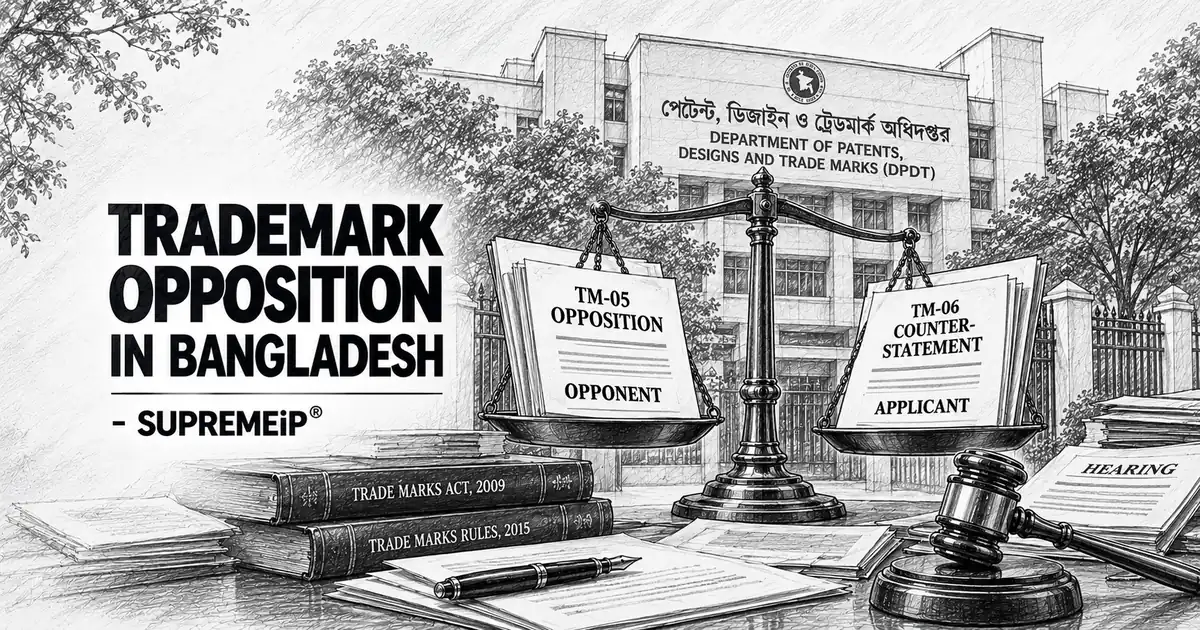
Trademarks Act, 2009  ·  Trademark Rules, 2015  ·  DPDT Bangladesh

Trademark Opposition in Bangladesh:
A Complete Legal Guide

Everything you need to know about trademark opposition in Bangladesh — stage-by-stage procedure, deadlines, evidence, and rights of both parties.
Protect your trademark in Bangladesh before registration closes.

2 Mo.
Filing Deadline
TM-05
Opposition Form
4 Stages
Procedure Steps
Sec 18
Governing Law
Appeal
Post-Decision
Sec. 18 — Opposition Rule 18 — TM-05 Notice Rule 19 — TM-06 Counter Rule 20 — Evidence Rule 22 — Hearing Rule 50 — HC Appeal Apostille & Legalization

In Bangladesh's increasingly competitive marketplace, protecting your brand identity is a strategic imperative. If you own a trademark in Bangladesh — or are in the process of registering one — and a third party's application threatens your rights through similarity, deception, or bad faith, the law gives you a powerful tool: Trademark Opposition. Governed by Section 18 of the Trademarks Act, 2009 and Rules 18–23 and 50 of the Trademark Rules, 2015, this formal adversarial proceeding before the Department of Patents, Designs and Trademarks (DPDT) is your first and most important line of defense.

This comprehensive guide covers every stage of trademark opposition in Bangladesh — from initial filing and counter-statements to affidavit evidence, hearings, the Registrar's decision, and High Court appeals — along with the specific rights and responsibilities of both the opponent and the applicant at each step.

What is Trademark Opposition in Bangladesh? A Legal Overview

Trademark opposition is a formal legal challenge filed against a trademark application that has been accepted and published in the Trademarks Journal by the DPDT. It is a pre-registration mechanism — meaning it must be initiated before the mark is officially registered, within a strict 2 months window from the date of journal publication.

Unlike a cancellation action (which is post-registration), opposition is proactive — it allows rights holders, competitors, and even members of the public to prevent an objectionable mark from ever entering the register in the first place.

Who Can File an Opposition?

Section 18(1) states: any person may file a trademark opposition. This includes:

  • Individuals, companies, partnerships
  • Owners of earlier registered trademarks
  • Owners of pending trademark applications
  • Owners of well-known marks (even unregistered)
  • Competitors with prior use in trade
  • Any person believing the mark should not be registered
When & Where to File?

Filing details under Rule 18:

  • Deadline: Within 2 months of the mark's publication in the Trademarks Journal
  • Where: DPDT office, Dhaka, Bangladesh
  • Form: TM-05 (in duplicate — two copies)
  • Fee: Prescribed government fee must be paid at filing
  • Extension: Not available — this deadline is absolute

Legal Grounds for Trademark Opposition in Bangladesh under the Trademarks Act 2009

Opposition cannot be filed on personal grievances alone — it must be grounded in a legally recognized basis. The Rule 18(2) requires the notice to contain all grounds the opponent relies upon. Common and legally accepted grounds under the Trademarks Act, 2009 include:

Ground 01 Similarity / Confusion

The applied mark is identical or confusingly similar to the opponent's earlier registered, pending, or well-known trademark. Confusion may arise in appearance, phonetics, or conceptual meaning.

Ground 02 Prior Use Rights

The opponent has been using the mark in Bangladesh prior to the applicant, creating prior rights in trade even without formal registration. Prior use confers common law rights enforceable in opposition.

Ground 03 Lack of Distinctiveness

The mark is generic, purely descriptive, or a common trade term incapable of functioning as a brand identifier under Sections 6 and 8 of the Trademarks Act, 2009.

Ground 04 Bad Faith

The applicant filed with dishonest intent — to exploit the opponent's reputation, block competition, or for speculative resale. Bad faith is an absolute bar under Section 8 of the Act.

Ground 05 Deceptive / Misleading

The mark is likely to deceive consumers about the nature, quality, geographical origin, or manufacturer of the goods/services — a ground under Section 8(c) of the Act.

Ground 06 Public Policy / Morality

The mark is scandalous, obscene, offensive to religious sentiments, or contrary to Bangladesh law. These are absolute bars under Section 8(a), (b), and (d) — no amount of evidence can overcome them.

Strategic Tip: An opposition notice may rely on multiple grounds simultaneously. It is advisable to include all available grounds in the initial notice (Form TM-05), as you cannot add new grounds after filing. A well-drafted notice supported by strong factual background and referenced earlier marks significantly increases your chances of success at the hearing stage.

Stage-by-Stage Procedure

Trademark Opposition in Bangladesh — Complete Process

Stage 1A — How to File a Trademark Opposition in Bangladesh: Notice of Opposition (Rule 18)

The trademark opposition in Bangladesh process commences when any person files a formal notice objecting to the registration of a published mark. Under Rule 18(1) of the Trademark Rules, 2015, the notice must be submitted within 2 months of the mark's publication in the Trademarks Journal — an absolute, non-extendable deadline.

STEP 1

Publication in Journal

DPDT publishes the accepted mark in the Trademarks Journal. The 2 months opposition window opens.

STEP 2

File Form TM-05

Opponent submits TM-05 in duplicate with prescribed fee and full statement of grounds.

STEP 3

DPDT Serves Copy

Within 1 month of receipt, the Registrar serves a copy of the opposition notice on the applicant via Form TMR-7.

DEADLINE

2 Months

Absolute filing deadline from journal publication. No extension possible under any circumstances.

⚖️ Opponent's Rights — Stage 1A

  • Right to oppose any published mark that conflicts with prior rights
  • Right to include all legal grounds simultaneously in TM-05
  • Right to request a copy of opponent's documents on payment
  • Right to be notified of applicant's counter-statement within 1 month

📋 Opponent's Duties — Stage 1A

  • Must file within strict 2 months deadline — no exceptions
  • Must include a full and detailed statement of all grounds (Rule 18(2))
  • Must submit TM-05 in duplicate with the prescribed government fee
  • If residing outside Bangladesh, may be required to deposit security for costs (Section 18(7))

Critical Warning: Failing to file Form TM-05 within 2 months of journal publication permanently forfeits your right to oppose that mark. The DPDT has no discretion to condone the delay. Monitor the Trademarks Journal regularly to protect your brand.

Stage 1B — Defending a Trademark in Bangladesh: Applicant's Counter-Statement (Rule 19 / Form TM-06)

After receiving the opposition notice, the trademark in Bangladesh applicant must formally respond. Under Rule 19(1), the applicant has 2 months from the date the DPDT serves the notice to file a counter-statement using Form TM-06 in duplicate. No extension is available — failure to respond is deemed abandonment of the application under Section 18(2).

⚖️ Applicant's Rights — Stage 1B

  • Right to 2 months to prepare and file the counter-statement
  • Right to contest all grounds raised in the opposition notice
  • Right to raise affirmative defenses (e.g., prior use, distinctiveness, different goods/services)
  • Right to receive a copy of the counter-statement within 1 month via Form TMR-7

📋 Applicant's Duties — Stage 1B

  • Must respond within 2 months of service of notice — no extension
  • Counter-statement must include all factual and legal grounds supporting their application (Rule 19(2))
  • Must address each allegation in the opposition notice directly
  • Failure to respond = application deemed abandoned under Section 18(2)

A strong counter-statement typically argues: (a) the marks are not confusingly similar; (b) the opponent's claimed rights are weak, unregistered, or unenforceable in Bangladesh; (c) the goods/services operate in different trade channels; or (d) the opponent has no bona fide interest in opposing.

Stage 2 — Evidence by Affidavit in Trademark Opposition in Bangladesh (Rule 20)

After the counter-statement phase, both parties in a trademark opposition in Bangladesh must substantiate their claims with legally verified evidence. Rule 20 governs this stage in detail — evidence is submitted in the form of affidavits (Form TM-18) and must be served on the opposing party by registered post simultaneously with filing at the DPDT.

Sub-Rule Who Acts Action & Form Deadline Consequence of Default
Rule 20(1) Opponent Files affidavit in evidence (TM-18) + serves copy on applicant 2 months after counter-statement received Opposition deemed abandoned (Rule 20(2))
Rule 20(3) Applicant Files affidavit in evidence (TM-18) + serves copy on opponent 2 months after receiving opponent's affidavit Application deemed abandoned (Rule 20(4))
Rule 20(5) Opponent (optional) Counter-affidavit (TM-18) in reply to applicant's affidavit 1 month after receiving applicant's affidavit Registrar proceeds without further notice
Opponent's Evidence Package
  • Legalized or apostilled affidavit
  • Certificates of trademark registration (Bangladesh & abroad)
  • Evidence of prior use: invoices, sales figures, annual reports
  • Advertising & marketing materials
  • Product packaging, labels, brochures
  • Media coverage, press clippings
  • Customer testimonials or declarations
  • Screenshots of website, social media presence
  • Business registration documents
  • Licensing or distribution agreements (if any)
Applicant's Evidence Package
  • Affidavit defending the application
  • Proof of own trademark registration or pending application
  • Evidence of independent development of the mark
  • Business registration documents
  • Sales figures, commercial activity records
  • Evidence that marks are sufficiently different
  • Proof of different goods/services categories
  • Brand advertisements, product catalogues
  • Licensing agreements or franchising documents
  • Expert opinion on likelihood of confusion (if available)

Affidavit Legalization vs. Apostille for Trademark in Bangladesh — What You Need to Know

Foreign opponents or applicants in a trademark opposition in Bangladesh cannot simply submit a locally notarized affidavit. The DPDT requires affidavits to be authenticated for international use. There are two recognized methods:

METHOD A Embassy Legalization
  1. Notarize affidavit in your home country
  2. Attestation at the Bangladesh Embassy or High Commission in your country
  3. Submit to Bangladesh and verify at the Ministry of Foreign Affairs

Available to all countries. More time-consuming & costly.

METHOD B Apostille (Hague Convention)
  1. Notarize affidavit in your home country
  2. Obtain a one-page Apostille certificate from your government
  3. Submit directly to DPDT — no embassy step needed

Bangladesh joined Hague Convention: July 29, 2024 · Accepts apostilles from: March 30, 2025

Important Update: Bangladesh officially joined the Hague Apostille Convention on July 29, 2024, and began accepting apostilled documents from March 30, 2025. If your country is a member of the Convention, using an apostille is now the faster, cheaper, and simpler alternative to embassy legalization for DPDT proceedings.

Stage 3 — DPDT Hearing: The Critical Stage of Trademark Opposition in Bangladesh (Rule 22)

Once the evidence stage of the trademark opposition in Bangladesh is complete, the Registrar schedules a formal hearing. Both parties are invited to appear, present oral arguments, and respond to the Registrar's questions. This is the most critical stage where the strength of each party's legal and factual case is tested.

Hearing Procedure — Step by Step
Rule 22(1)

Registrar issues Hearing Notice (Form TMR-13) to both parties. The scheduled hearing date must be at least 1 month after the notice is served, unless parties consent to a shorter period.

Rule 22(2)

Any party wishing to be heard must file Form TM-07 with the prescribed fee within 14 days of receiving the hearing notice. Failure to file TM-07 = treated as waiving the right to appear.

Rule 22(3)

If a party files TM-07 but fails to appear, or does not file TM-07 at all, the Registrar may proceed with or without hearing and issue a decision in that party's absence — or make such other order as seems fit.

Rule 22(4)

If a decision is made in a party's absence, that party may apply for reconsideration — the Registrar may, at their discretion, rehear the matter subject to such conditions (including costs) as they see fit.

Rule 22(5)

If neither party appears, the Registrar may dismiss the entire opposition proceeding — though either party may later apply for reconsideration or reinstatement.

⚖️ Both Parties' Rights — Stage 3

  • Right to present oral arguments before the Registrar
  • Right to cross-examine the opposing party's affidavit claims
  • Right to request additional time or adjournments (at Registrar's discretion)
  • Right to be represented by a registered Trademark Agent or Advocate
  • Right to apply for reconsideration if decision was made in absence

📋 Both Parties' Duties — Stage 3

  • Must file Form TM-07 within 14 days of receiving Hearing Notice
  • Must attend the hearing or risk decision being made in absence
  • Must present arguments confined to evidence already on record
  • Must comply with Registrar's procedural directions during hearing

Stage 4 — Registrar's Decision in Trademark Opposition in Bangladesh (Rules 22–23)

After hearing both parties and reviewing all evidence in the trademark opposition in Bangladesh proceeding, the Registrar delivers a written decision under Section 18(5). The decision is then communicated to both parties in writing within 1 month via Form TMR-19 (Rule 23).

Opposition Succeeds

The application is refused or granted only with modifications, conditions, or restricted scope. The mark does not proceed to registration.

Conditional Registration

The Registrar may allow registration subject to amendments, limitations, or conditions — e.g., limited to specific goods, disclaimed elements, or a specific territory.

Opposition Fails

The application proceeds to full registration. The Registrar records the decision, and the mark is entered in the Register of Trademarks.

Stage 5 — Appealing a Trademark in Bangladesh: High Court Division (Rule 50)

Any party aggrieved by the Registrar's decision in a trademark opposition in Bangladesh may challenge it before the High Court Division of the Supreme Court of Bangladesh. This right of appeal is governed by Rule 50 of the Trademark Rules, 2015.

Appeal Requirements — Rule 50

  • Deadline: Within 2 months from receipt of the Registrar's decision copy
  • Court: High Court Division of the Supreme Court of Bangladesh
  • Must name a Trademark Agent or Advocate in the appeal
  • A copy of the appeal (with case number) must be filed with the DPDT Registry
  • Either the opponent or the applicant may file the appeal

Grounds for HC Appeal

  • Error of law in the Registrar's decision
  • Failure to consider material evidence
  • Procedural irregularity affecting the outcome
  • Misapplication of provisions of the Trademarks Act, 2009
  • Fresh evidence not available at DPDT stage (in exceptional cases)

Complete Timeline Summary: Trademark Opposition in Bangladesh

Under Section 18(8), the entire trademark opposition in Bangladesh proceeding must be completed within 330 working days from the date the opposition notice is filed. In practice, depending on the complexity of the case and party responsiveness, the process typically spans 2 to 4 years end-to-end including any appeals.

Stage Action Form Who Deadline Rule
Stage 1A File Notice of Opposition TM-05 Opponent Day 0 + 2 months (from publication) Rule 18(1)
Stage 1A DPDT serves copy to applicant TMR-7 DPDT 1 month after TM-05 received Rule 18(3)
Stage 1B File Counter-Statement TM-06 Applicant 2 months from service of notice Rule 19(1)
Stage 1B DPDT serves copy to opponent TMR-7 DPDT 1 month after TM-06 received Rule 19(3)
Stage 2A Opponent's Affidavit in Evidence TM-18 Opponent 2 months after counter-statement received Rule 20(1)
Stage 2B Applicant's Affidavit in Evidence TM-18 Applicant 2 months after opponent's affidavit received Rule 20(3)
Stage 2C Counter-Affidavit (optional reply) TM-18 Opponent 1 month after applicant's affidavit received Rule 20(5)
Stage 3 Confirm Hearing Attendance TM-07 Both Parties 14 days after hearing notice (TMR-13) Rule 22(2)
Stage 4 Registrar's Decision Communicated TMR-19 DPDT Within 1 month of decision date Rule 23
Stage 5 Appeal to High Court Division Court Filing Aggrieved Party 2 months from receipt of Registrar's decision Rule 50(1)

Special Provisions for Trademark Opposition in Bangladesh: Security for Costs & Exhibits (Sections 18(7), Rules 20–21)

The Trademarks Act and Rules include specific provisions for trademark in Bangladesh proceedings dealing with parties residing outside Bangladesh and the handling of exhibits in opposition cases.

Security for Costs — Section 18(7)

If an opponent or applicant does not reside or carry on business in Bangladesh, the Registrar may direct that person to deposit security for the costs of the proceedings.

Consequence: If the required security is not deposited in time, the opposition notice or application (as the case may be) shall be deemed abandoned.

Exhibits & Inspection — Rule 21

When any party files evidence or exhibits by affidavit, the filing party must provide copies to the opposing party on request and at the requesting party's cost.

All documents filed with the Registrar under Chapter [Opposition] are open to public inspection via the register — meaning any third party may inspect the evidence in the proceeding.

Conclusion: Why Trademark Opposition in Bangladesh Matters

Trademark opposition in Bangladesh is not a procedural hurdle — it is a critical legal safeguard that protects the identity, goodwill, and exclusivity of your brand. The system under the Trademarks Act, 2009 and Trademark Rules, 2015 is carefully structured to give both opponents and applicants a fair and evidence-based hearing before the Registrar of the DPDT.

Whether you are filing an opposition to protect your trademark in Bangladesh from a confusingly similar newcomer, or defending your own application against a challenge, success depends on four pillars:

01

Act on Time

Monitor the Trademarks Journal. The 2 months window to oppose is absolute — miss it and you lose all opposition rights permanently.

02

Draft Well

A comprehensive TM-05 notice citing all available grounds builds the strongest foundation. You cannot add grounds later.

03

Evidence Wins

Submit properly legalized or apostilled affidavits with robust commercial evidence. Weak evidence = weak case at the hearing.

04

Attend & Argue

File TM-07 on time and attend the hearing with experienced counsel. The Registrar can decide against you in your absence.

Frequently Asked Questions — Trademark Opposition in Bangladesh

Click any question to expand the answer.

Q01 What is trademark opposition in Bangladesh?
Trademark opposition is a formal legal proceeding under Section 18 of the Trademarks Act, 2009 that allows any person to challenge the registration of a trademark after it has been published in the Trademarks Journal by the DPDT. It is a pre-registration mechanism — the opposition must be filed before the mark achieves registration status.
Q02 Who can file a trademark opposition in Bangladesh?
Under Section 18(1), any person may file an opposition — including individuals, companies, partnerships, associations, and foreign entities. You do not need to be a registered trademark owner; prior use in trade or any legitimate interest in preventing registration is sufficient.
Q03 What is the deadline to file a trademark opposition in Bangladesh?
The deadline is 2 months from the date of publication of the trademark application in the Trademarks Journal, as per Rule 18(1) and Section 18(1) of the Trademarks Act, 2009. This deadline is absolute — no extension is available under any circumstances.
Q04 Can the 2 months opposition deadline be extended?
No. The 2 months deadline under Rule 18(1) and Section 18(1) is strict and non-extendable. The DPDT Registrar has no discretion to condone or extend this period regardless of the reason. Missing this window permanently forfeits the right to oppose that mark.
Q05 What form is used to file a trademark opposition in Bangladesh?
A trademark opposition is filed using Form TM-05 under Rule 18(1) of the Trademark Rules, 2015. The form must be submitted in duplicate (two copies) along with the prescribed government fee at the DPDT office.
Q06 What grounds are available for trademark opposition in Bangladesh?
Common legal grounds include: (1) similarity or likelihood of confusion with an earlier mark; (2) prior use rights; (3) lack of distinctiveness; (4) bad faith filing; (5) deceptive or misleading nature; (6) marks offensive to public morality or religious sentiments; (7) use of restricted symbols, flags, or national emblems without authorization; and (8) marks contrary to law. Under Rule 18(2), all grounds must be included in the TM-05 notice — you cannot add new grounds later.
Q07 Do I need a Power of Attorney to file a trademark opposition?
Yes. If you appoint a Trademark Agent, law firm, or advocate to represent you at the DPDT, a Power of Attorney (POA) is required. The POA must authorize the agent to act on your behalf in the opposition proceedings. For foreign opponents, the POA may need to be notarized and legalized or apostilled.
Q08 What is a counter-statement in trademark opposition proceedings?
A counter-statement is the trademark applicant's formal written response to the opposition notice. It is filed using Form TM-06 under Rule 19, in duplicate, within 2 months of receiving the opposition notice from the DPDT. The counter-statement must set out all factual and legal grounds supporting the applicant's mark and must address the allegations in the opposition notice directly.
Q09 What happens if the applicant fails to file the counter-statement?
Under Section 18(2), if the applicant fails to file a counter-statement (Form TM-06) within 2 months of receiving the opposition notice, the applicant is deemed to have abandoned their application. The trademark application will not proceed to registration, and the opposition effectively succeeds by default.
Q10 What is an "Affidavit in Evidence" in trademark opposition?
An "Affidavit in Evidence" is a sworn, legally verified statement filed using Form TM-18 under Rule 20. It contains all factual evidence — documents, exhibits, commercial records — that the filing party relies upon to support their position. The opponent files first (within 2 months of the counter-statement), followed by the applicant (within 2 months of receiving the opponent's affidavit). All affidavits must be served on the opposing party by registered post simultaneously with filing at the DPDT.
Q11 What happens if the opponent fails to file evidence (affidavit)?
Under Rule 20(2), if the opponent fails to file their affidavit in evidence within the 2 months period after receiving the counter-statement, their opposition is deemed abandoned. The trademark application then proceeds without the opposition, and the applicant's mark may be registered.
Q12 What documents should be included in the opponent's affidavit?
The opponent's affidavit (Form TM-18) should include: trademark registration certificates (Bangladesh and overseas), evidence of prior use (invoices, sales data, annual reports), advertising and marketing materials, product packaging and labels, press clippings and media coverage, screenshots of online presence and social media, customer declarations or testimonials, and business registration documents. For foreign opponents, the affidavit must be legalized or apostilled.
Q13 What is the difference between legalization and apostille for DPDT affidavits?
Legalization requires the affidavit to be notarized, then attested at the Bangladesh Embassy/High Commission in your country, and finally verified by Bangladesh's Ministry of Foreign Affairs. Apostille is available if your country is a signatory to the Hague Convention — a one-page certificate issued by your government eliminates the embassy step. Bangladesh joined the Hague Apostille Convention on July 29, 2024 and has been accepting apostilled documents since March 30, 2025. Apostille is significantly faster and cheaper.
Q14 When did Bangladesh start accepting apostilled documents?
Bangladesh officially joined the Hague Apostille Convention on July 29, 2024 and began accepting apostilled documents in official proceedings — including DPDT filings — from March 30, 2025. This is a significant development that simplifies affidavit authentication for foreign parties in trademark opposition proceedings.
Q15 What is a counter-affidavit and is it mandatory?
A counter-affidavit is an optional reply by the opponent to address new arguments or evidence raised in the applicant's affidavit. It must be filed using Form TM-18 within 1 month of receiving the applicant's affidavit (Rule 20(5)). While not mandatory, it is strategically important if the applicant's affidavit introduces new factual claims. The counter-affidavit must be strictly confined to responding to the applicant's evidence — new material outside that scope is not permitted.
Q16 What is Form TMR-13 and when is it issued?
Form TMR-13 is the Hearing Notice issued by the DPDT Registrar after the evidence stage is complete. Under Rule 22(1), it is served on both parties and must specify a hearing date that is at least 1 month after the date of service — unless both parties agree to a shorter notice period. Upon receiving TMR-13, each party must file Form TM-07 within 14 days to confirm their wish to attend the hearing.
Q17 How do I confirm attendance for the trademark opposition hearing?
To confirm attendance at the hearing, you must file Form TM-07 with the prescribed fee at the DPDT within 14 days of receiving the Hearing Notice (Form TMR-13), as required by Rule 22(2). Failure to file TM-07, or failure to appear after filing it, means you are treated as having waived your right to participate in the oral hearing — the Registrar may then decide the case on existing documents alone.
Q18 Can a decision be made in my absence at the hearing?
Yes. Under Rule 22(3), if a party does not file TM-07 or files it but fails to appear at the hearing, the Registrar may proceed to issue a decision in that party's absence — based entirely on the written record (pleadings, affidavits). However, under Rule 22(4), the absent party may subsequently apply for reconsideration, which the Registrar may grant subject to conditions such as payment of costs.
Q19 What can the Registrar decide in a trademark opposition?
Under Section 18(5), the Registrar may: (a) accept the application in full — opposition fails, mark proceeds to registration; (b) refuse the application with reasons recorded — opposition succeeds; or (c) accept the application subject to modifications, conditions, limitations or restrictions — partial success for either side. Under Section 18(6), any such conditions are recorded and form part of the registration.
Q20 How is the Registrar's decision communicated?
Under Rule 23, the Registrar must notify both parties of the decision in writing using Form TMR-19 within 1 month of the date the decision is made. The date of receipt of this notification is critical, as it triggers the 2 months window for filing a High Court appeal.
Q21 Can I appeal the DPDT Registrar's opposition decision?
Yes. Under Rule 50(1), any aggrieved party — whether the opponent or applicant — may appeal the Registrar's decision to the High Court Division of the Supreme Court of Bangladesh within 2 months of receiving the decision notification (Form TMR-19). The appeal must name a Trademark Agent or Advocate, and a copy of the filed appeal must be submitted to the DPDT Registry under Rule 50(2).
Q22 What is the maximum working day limit for the entire opposition process?
Under Section 18(8) of the Trademarks Act, 2009, all proceedings in a trademark opposition must be completed within 330 working days from the date the opposition notice (Form TM-05) is filed. This statutory cap is designed to prevent indefinite delays at the DPDT. However, in practice, appeals to the High Court operate outside this limit.
Q23 How long does a trademark opposition take in Bangladesh?
The full opposition process, from filing TM-05 to the Registrar's decision, typically takes 2 to 4 years in practice — depending on the complexity of the case, how quickly parties meet their deadlines, and the number of hearings required. Section 18(8) mandates a maximum of 330 working days for the DPDT proceedings, but delays in scheduling hearings or procedural extensions can extend timelines. Including a High Court appeal, the process can take significantly longer.
Q24 Can additional evidence be filed after the evidence stage closes?
Generally, no. Under Rule 20(7), once the evidence stage is complete, no party may file further evidence — unless the Registrar, in their discretion, grants permission for a party to do so on such conditions (including payment of costs) as the Registrar considers appropriate. Such permission is an exception, not the rule, and requires a formal application.
Q25 Can a foreign opponent or applicant be required to deposit security for costs?
Yes. Under Section 18(7) of the Trademarks Act, 2009, if either the opponent or applicant does not reside or carry on business in Bangladesh, the Registrar may direct that party to deposit security for the costs of the proceedings. If the required security is not provided in time, the opposition notice or application (as applicable) is deemed abandoned. This provision protects the other party from cost exposure if a foreign party abandons the proceeding.
Q26 Are opposition documents open to public inspection?
Yes. Under Rule 21(2), all evidence and documents filed in opposition proceedings with the Registrar are open to inspection in the register. This means any third party — including competitors — can access the filed affidavits, exhibits, and other documents that are part of the opposition record.
Q27 What is the difference between trademark opposition and trademark cancellation in Bangladesh?
Trademark opposition (Section 18) is a pre-registration challenge — filed after journal publication but before registration is granted. Trademark cancellation or revocation is a post-registration remedy, filed after a mark has already been registered. Opposition is generally faster and less costly than cancellation, which is why monitoring the Trademarks Journal and acting within the 2 months window is crucial for protecting your brand.
Q28 Can the parties settle or withdraw an opposition after filing?
Yes. Parties may reach a negotiated settlement at any stage of the opposition — for example, through a co-existence agreement, trademark licensing arrangement, or agreed limitation of the applicant's goods/services. The opponent can withdraw the opposition notice, and the applicant's mark may then proceed to registration (potentially with agreed conditions). The Registrar must be formally notified of any withdrawal or settlement for it to take effect in the proceedings.
Q29 Can a pending trademark application be opposed in Bangladesh?
Yes — an opponent may rely on their own pending trademark application as a basis for opposition, in addition to registered marks or prior use rights. If the opponent's application is still pending at the DPDT, it can still form part of the legal grounds for challenging the published mark, particularly where it was filed before the application under opposition.
Q30 Why should I hire a trademark attorney or agent for opposition proceedings?
Trademark opposition is a multi-stage adversarial legal proceeding with strict, non-extendable deadlines. A poorly drafted TM-05 notice, an incomplete affidavit, or a missed TM-07 filing can result in your case being abandoned or decided against you by default. A qualified trademark attorney ensures all grounds are correctly articulated, all deadlines are met, affidavits are properly prepared and legalized, and oral arguments at the hearing are effectively presented. The cost of professional representation is far lower than the cost of losing your brand protection rights.
Q31 What is Form TMR-7 and what is its role in opposition?
Form TMR-7 is the standard DPDT form used to serve copies of documents between parties in proceedings — including serving the opposition notice to the applicant (Rule 18(3)) and serving the counter-statement to the opponent (Rule 19(3)). The DPDT issues TMR-7 within 1 month of receiving the relevant document, and the date of service via TMR-7 triggers the next party's deadline.
Q32 How does trademark opposition in Bangladesh protect well-known international brands?
Bangladesh's opposition system allows foreign brand owners to challenge confusingly similar marks even if they are not yet registered in Bangladesh — prior use, well-known status, and reputation evidence can form valid grounds for opposition. The bad faith ground under Section 8 is particularly powerful against "trademark squatters" who file well-known foreign marks to extract commercial benefit. Since Bangladesh accepts apostilles from March 2025, international brands can now file evidence more efficiently than ever before.
Protecting Your Ideas, Powering Your Brand in Bangladesh

SUPREMEiP Law Firm

Where Innovation Meets Legal Protection

📞 WhatsApp: +8801613336333  ·  📧 info@supremeip.com  ·  💬 WeChat: SUPREMEiP