
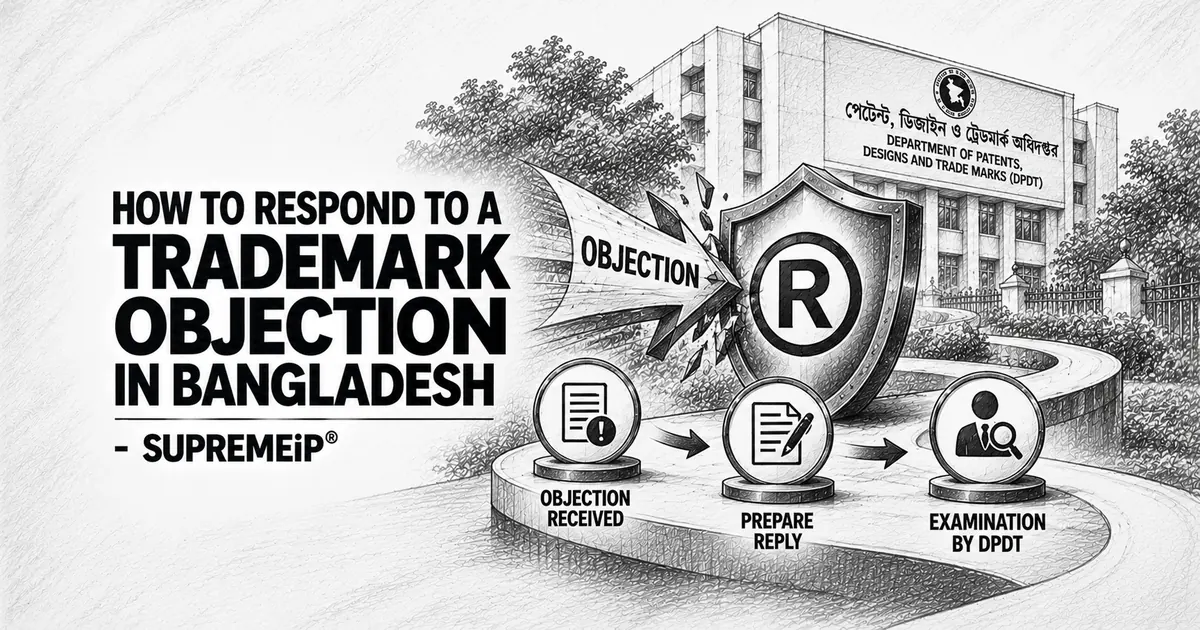
How to Respond to a Trademark Objection
in Bangladesh — Complete Legal Guide
Step-by-step strategy to respond to a DPDT Show Cause Notice, overcome grounds for objection,
and keep your trademark application on track.
When you file a trademark application with the Department of Patents, Designs and Trademarks (DPDT) in Bangladesh, the Registrar of Trademarks conducts a formal examination under Rule 14 of the Trademark Rules, 2015. If the mark does not meet the requirements of the Trademarks Act, 2009, the DPDT issues a formal Show Cause Notice — commonly known as a trademark objection or Office Action (Examination Report).
This guide explains — step by step — how to respond to a trademark objection in Bangladesh, what happens after you respond, and what options are available if your application is rejected or abandoned. Whether you are a local business owner or an international brand seeking protection through an IP law firm in Bangladesh, this guide covers everything you need to know.
1. The Trademark Examination Process in Bangladesh
Once a trademark application is filed at the DPDT, the Registrar of Trademarks begins the examination process under Rule 14 of the Trademark Rules, 2015. This examination typically takes approximately two months from the date of filing.
During examination, the Registrar checks the application against the following criteria under the Trademarks Act, 2009:
✅ If no issues are found: The mark proceeds to publication in the Bangladesh Trademark Journal. ⚠️ If issues are found: The DPDT issues a formal Show Cause Notice (Examination Report) — this is the trademark objection.
2. What is a Trademark Show Cause Notice (Office Action) in Bangladesh?
A Show Cause Notice — formally called an Examination Report or Trademark Office Action in Bangladesh — is an official written notice from the DPDT Registrar explaining the specific grounds on which your trademark application cannot currently proceed.
The Show Cause Notice will typically cite one or more of the following grounds under the Trademarks Act, 2009:
| Section | Ground for Objection | Example |
|---|---|---|
| Sec. 6(1)(c) | Mark lacks an invented word | "SUPERFAST" for courier services |
| Sec. 6(1)(e) | Mark is not distinctive | Generic words describing the product |
| Sec. 8(c) | Mark may deceive or cause confusion | Mark implies false quality or origin |
| Sec. 8(d) | Hurts religious sentiments | Religious symbols misused commercially |
| Sec. 10(1) | Identical/similar to existing registered mark | Confusingly similar logo or name |
| Sec. 10(4) | Conflicts with well-known trademark | Mark takes unfair advantage of famous brand |
| Sec. 11 | Improper use of personal or geographical name | Using a person's name without consent |
3. How to Respond to a Trademark Objection in Bangladesh — Step by Step
Once you receive a Show Cause Notice from the DPDT, you must respond under Rule 15 of the Trademark Rules, 2015. Here is the complete step-by-step process:
Receive & Analyse the Show Cause Notice
Carefully read the Examination Report to identify every ground cited. Note the date of receipt — this starts the countdown for your reply deadline.
Observe the Reply Deadline (Rule 15)
You must file your Show Cause reply within 2 months of receipt of the Notice. An extension of a further 2 months is available on application — giving a maximum of 4 months total.
Prepare Legal Arguments & Evidence
Address every ground cited in the Notice. Prepare legal arguments under the Trademarks Act, 2009, and gather supporting evidence such as: proof of prior use, evidence of acquired distinctiveness, consent letters (NOC) from existing mark owners, sales/marketing evidence, international registrations, or expert opinion.
Submit the Show Cause Reply to DPDT
File the formal written reply with the DPDT, addressing all cited grounds. The reply should include your legal arguments, evidence annexures, and — if needed — a request for a Hearing before the Registrar (Rule 15(2)).
Attend the Hearing (if requested or called)
If the Registrar requires oral arguments, you (or your IP attorney) will attend a Hearing at the DPDT. This is your opportunity to supplement your written reply with additional submissions and respond to the Registrar's queries in person.
Await the Registrar's Decision (Rule 15(5))
✅ If the reply is accepted: The application proceeds to publication in the Bangladesh Trademark Journal. ❌ If the reply is rejected: The application is refused — but you have further legal remedies available (see below).
4. What Happens if the Trademark Application is Rejected?
If the Registrar refuses the trademark application after considering your Show Cause reply, you are not without recourse. The following legal remedies are available under the Trademarks Act, 2009:
📋 Certified Copy — Rule 15(7)
Request a certified copy of the Registrar's decision — this is required before filing an appeal or review.
⚖️ Appeal to High Court — Section 100
File an appeal to the High Court Division within 2 months of the certified copy of the Registrar's decision.
🔄 Review — Rule 65(1) & Section 91(5)
Apply for a review of the Registrar's decision within the appeal period — an alternative to or precursor to a High Court appeal.
5. What if I Don't Respond? — Abandonment & Restoration
If you fail to file a Show Cause reply within the prescribed deadline, your trademark application will be automatically abandoned under Rule 15(3) of the Trademark Rules, 2015.
⚠️ Important DPDT Practice Note: In Bangladesh, the DPDT frequently delays issuing formal abandonment notices by 2–3 years from the date of abandonment. This delay also pushes back your window to apply for restoration — but it does not extend the statutory 5-year limit.
If your application has been abandoned, you have two main options:
6. Summary Table — Trademark Examination, Office Action & Objection Response in Bangladesh
| Stage | Rule / Section | Timeline | Your Action |
|---|---|---|---|
| Examination | Rule 14 + Secs. 6, 8, 9, 10, 11, 67, 120 | ~2 months from filing | Monitor application status |
| Office Action | Rule 15 | After examination | Receive & analyse Show Cause Notice |
| Objection Reply | Rule 15(2) | 2 months (+ 2 months extension) | File written reply with arguments & evidence |
| Registrar Decision | Rule 15(5) | After reply / hearing | Accepted → publication; Refused → appeal |
| Appeal / Review | Sec. 100, Rule 65(1), Sec. 91(5) | 2 months from certified copy | Appeal to High Court Division |
| Abandonment | Rule 15(3) | If no reply is filed | Apply for restoration or refile |
| Restoration | Rule 15(3) | Within 5 years of abandonment notice | Apply with restoration fee + condonation |
7. Why Responding to a Trademark Objection in Bangladesh Matters
Failing to respond properly — or at all — to a trademark objection can have serious consequences for your business. Responding correctly and on time is important because:
Brand Protection
A registered trademark in Bangladesh gives you exclusive rights to use the mark and take legal action against infringers.
Enforcement Rights
Trademark registration is a prerequisite for border detention, customs recordal, and civil/criminal enforcement actions in Bangladesh.
Renewals & Licensing
A registered mark can be renewed every 10 years and licensed/assigned — generating long-term commercial value.
Opposition Rights
Only a registered trademark owner can oppose the registration of a conflicting later mark in the Bangladesh Trademark Journal.
8. Key Takeaways
- The trademark examination process in Bangladesh takes place under Rule 14 of the Trademark Rules, 2015.
- A Show Cause Notice / Office Action is issued under Rule 15 when the Registrar has grounds to refuse your application.
- You must file a Show Cause reply within 2 months of receipt, extendable by a further 2 months.
- Your reply should contain legal arguments addressing every cited ground, supported by relevant evidence.
- If the reply is rejected, you may appeal to the High Court Division (Section 100) or apply for a review (Rule 65(1) / Section 91(5)) within 2 months.
- Failure to respond results in automatic abandonment under Rule 15(3) — but restoration within 5 years or a fresh filing remains possible.
- Engaging a qualified IP law firm in Bangladesh significantly improves the chances of overcoming a trademark objection.
Frequently Asked Questions (FAQ)
Click any question to expand the answer.
01 What is a trademark objection in Bangladesh? ▼
A trademark objection in Bangladesh is a formal written notice issued by the Registrar of Trademarks at the DPDT after examining your application under Rule 14 of the Trademark Rules, 2015. The notice — also called a Show Cause Notice or Examination Report — sets out the specific legal grounds under the Trademarks Act, 2009 on which the Registrar believes your mark cannot currently proceed to registration. Receiving an objection does not mean your application is refused; it is an invitation to respond and justify why your mark should be registered.
02 What is a Show Cause Notice in trademark proceedings in Bangladesh? ▼
A Show Cause Notice in trademark proceedings is the official DPDT document informing the applicant of the Registrar's objections to the trademark application. It is governed by Rule 15 of the Trademark Rules, 2015 and requires the applicant to "show cause" — i.e. provide legal reasoning and evidence — as to why the application should not be refused. The notice will specify the sections of the Trademarks Act, 2009 under which the objection is raised (e.g. Section 6, 8, 10) and must be responded to within the prescribed time limit.
03 How long do I have to respond to a trademark objection in Bangladesh? ▼
Under Rule 15 of the Trademark Rules, 2015, you must file your Show Cause reply within 2 months from the date of receipt of the notice. An extension of a further 2 months may be granted on application — giving a maximum response window of 4 months in total. Failure to respond within this extended period will result in automatic abandonment of the application under Rule 15(3).
04 What should a Show Cause reply to a trademark objection in Bangladesh include? ▼
A well-drafted Show Cause reply should include: (1) a formal address to the Registrar of Trademarks, DPDT; (2) a reference to the application number and examination report date; (3) legal arguments addressing each ground cited in the Notice — with citations to relevant provisions of the Trademarks Act, 2009; (4) evidence annexures such as proof of prior use, sales records, advertising materials, international registrations, and declarations; (5) where applicable, an NOC or consent letter from the owner of any cited conflicting mark; (6) a request for a Hearing under Rule 15(2) if oral arguments are needed; and (7) a formal prayer requesting that the application be accepted and proceed to publication.
05 What is the trademark examination process in Bangladesh? ▼
After filing a trademark application with the DPDT, the Registrar of Trademarks conducts a formal examination under Rule 14 of the Trademark Rules, 2015. The examination typically takes approximately two months from the date of filing. The Registrar checks: whether the mark is distinctive (Sections 6); whether it falls under prohibited categories (Section 8); whether it is a chemical name (Section 9); whether it conflicts with existing registered marks or well-known marks (Section 10); and whether it improperly uses personal or geographical names (Section 11). If the application passes all checks, it proceeds to publication in the Bangladesh Trademark Journal. If not, a Show Cause Notice is issued.
06 What are the most common grounds for trademark objection in Bangladesh? ▼
The most common grounds for trademark objection in Bangladesh are: (1) Section 6(1)(e) — lack of distinctiveness (the mark is descriptive, generic, or lacks the ability to distinguish the applicant's goods/services); (2) Section 10(1) — the mark is identical or confusingly similar to an existing registered trademark for identical or similar goods/services; (3) Section 6(1)(c) — the mark lacks an invented or coined word; (4) Section 8(c) — the mark is likely to deceive or cause confusion; and (5) Section 10(4) — the mark conflicts with a well-known trademark. Together these grounds account for the vast majority of Show Cause Notices issued by the DPDT.
07 What happens if I don't respond to a trademark objection in Bangladesh? ▼
If you fail to respond to the Show Cause Notice within the prescribed deadline (2 months, extendable by 2 months), your trademark application will be automatically abandoned under Rule 15(3) of the Trademark Rules, 2015. Once abandoned, the application ceases to exist as a pending registration. However, you can apply for restoration within 5 years of the abandonment notice being issued, or file a fresh trademark application for the same mark. Note that the DPDT sometimes delays issuing formal abandonment notices by 2–3 years, but this does not extend the statutory 5-year restoration window from the date of abandonment.
08 Can I get an extension for responding to a trademark objection in Bangladesh? ▼
Yes — under Rule 15 of the Trademark Rules, 2015, you may apply to the Registrar for an extension of time to respond to the Show Cause Notice. The extension available is up to 2 additional months, which extends the total response window from 2 months to a maximum of 4 months. The extension request should be filed before the original 2-month deadline expires. It is advisable to file the extension request promptly if you require more time to gather evidence or prepare a comprehensive reply.
09 What is a Hearing before the Registrar in a trademark objection matter? ▼
A Hearing before the Registrar is an oral proceeding at the DPDT where the applicant (or their attorney) can present legal arguments and respond to the Registrar's queries in person. Under Rule 15(2) of the Trademark Rules, 2015, an applicant may request a Hearing as part of the Show Cause reply process. Hearings are typically requested where the written reply alone may not sufficiently address the Registrar's concerns, or where complex legal arguments need to be presented orally. The Registrar retains full discretion to allow or refuse a Hearing request, and may also call a Hearing on their own initiative.
10 What happens after the Registrar accepts my Show Cause reply? ▼
If the Registrar is satisfied with your Show Cause reply and accepts the application, the trademark will proceed to publication in the Bangladesh Trademark Journal. After publication, there is a 2-month opposition period during which any third party may file an opposition to the registration. If no opposition is filed (or if any opposition is overcome), the trademark will be formally registered and a Certificate of Registration will be issued, providing legal protection for an initial period of 7 years, renewable for subsequent 10-year periods under Section 28 of the Trademarks Act, 2009.
11 How do I appeal a rejected trademark application in Bangladesh? ▼
If the Registrar refuses your trademark application after considering your Show Cause reply, you may appeal to the High Court Division of the Supreme Court of Bangladesh under Section 100 of the Trademarks Act, 2009. The appeal must be filed within 2 months from the date of receiving a certified copy of the Registrar's decision (obtainable under Rule 15(7)). Alternatively, you may apply for a review of the Registrar's decision under Rule 65(1) and Section 91(5) within the same period. Engaging an Advocate admitted to the Supreme Court of Bangladesh to handle the appeal is strongly recommended.
12 Can I restore a trademark application that was abandoned in Bangladesh? ▼
Yes — under Rule 15(3) of the Trademark Rules, 2015, an abandoned trademark application may be restored within 5 years of the date of the abandonment notice being issued by the DPDT. To apply for restoration, you must pay the prescribed restoration fee and typically submit a request explaining the reasons for the failure to respond and requesting condonation of the delay. In practice, the DPDT sometimes delays issuing abandonment notices by 2–3 years after actual abandonment — but this does not extend your 5-year restoration window, which runs from the actual abandonment date.
13 What evidence is useful when responding to a Section 6 distinctiveness objection? ▼
When responding to a Section 6 distinctiveness objection, the following evidence is most effective: (1) Proof of prior use — invoices, bills, delivery records, and photographs showing the mark in commercial use in Bangladesh; (2) Advertising and promotional materials — showing long-standing and continuous use; (3) Sales volume and revenue figures showing the commercial scale of use; (4) Customer declarations or affidavits attesting to recognition of the mark; (5) International registrations in other jurisdictions confirming the mark has been accepted as distinctive globally; and (6) Expert opinion on the distinctiveness of the mark in the relevant trade sector. The goal is to demonstrate that the mark has acquired secondary meaning or acquired distinctiveness through long and continuous use in Bangladesh.
14 What is the best strategy to respond to a Section 10(1) similarity objection? ▼
To respond to a Section 10(1) objection (similarity to existing registered mark), the best strategies are: (1) Visual, phonetic, and conceptual comparison — demonstrate that your mark differs sufficiently from the cited registered mark to avoid consumer confusion; (2) Obtain an NOC (No Objection Certificate / Consent Letter) from the owner of the cited mark, establishing that they consent to co-existence; (3) Challenge the relevance of the goods/services — show that your goods/services are so different from those of the registered mark that confusion is unlikely; (4) Demonstrate prior use of your mark in Bangladesh predating the cited registered mark; or (5) Apply to cancel or rectify the earlier mark if it is not in genuine use. An NOC from the senior mark's owner is often the most practical and quickest solution.
15 What is an NOC (No Objection Certificate) and how does it help overcome a trademark objection? ▼
A No Objection Certificate (NOC) — also called a Consent Letter — is a formal document from the owner of an existing registered trademark consenting to the registration of your applicant mark notwithstanding their own earlier registration. When filed with the DPDT as part of your Show Cause reply to a Section 10(1) or Section 10(4) objection, an NOC can be decisive in persuading the Registrar that there is no genuine risk of consumer confusion or commercial conflict. The NOC should be notarised, signed by an authorised representative of the senior mark's owner, and specifically reference both the senior registration and your pending application by their registration/application numbers.
16 Can a trademark objection in Bangladesh be overcome without a Hearing? ▼
Yes — many trademark objections in Bangladesh are successfully overcome through a well-drafted written Show Cause reply alone, without the need for an oral Hearing. If the written reply is legally cogent, comprehensively addresses all cited grounds, and is supported by strong evidence, the Registrar may accept the application on the papers alone. A Hearing (under Rule 15(2)) is typically requested or granted where the objection is complex, where the written reply needs supplementation, or where the Registrar has remaining questions after reviewing the written submission. Requesting a Hearing does not adversely affect your application — it simply provides an additional opportunity to present arguments.
17 What is the difference between a trademark objection and a trademark opposition in Bangladesh? ▼
A trademark objection is raised by the DPDT Registrar during examination — before publication. It is an internal administrative stage and only the applicant and the DPDT are involved. A trademark opposition, by contrast, is raised by a third party (e.g. an existing trademark owner) after the application is published in the Bangladesh Trademark Journal. Opposition is governed by Sections 17–23 of the Trademarks Act, 2009 and the applicable Trademark Rules, and involves adversarial proceedings between the applicant and the opposing party. The key difference is timing: objections occur pre-publication (examination stage); oppositions occur post-publication (within the 2-month opposition window).
18 How long does the trademark objection response process take in Bangladesh? ▼
After filing the Show Cause reply, the Registrar's decision timeline varies depending on the complexity of the matter and DPDT workload. In practice: straightforward applications where the reply is accepted on the papers may proceed to publication within a few months of the reply being filed; applications requiring a Hearing may take longer — 6 to 12 additional months or more after the Hearing date; and applications involving complex grounds or high-value marks may involve extended procedural steps. The overall Bangladesh trademark registration process — from filing to certificate — typically takes 2 to 5 years depending on objections, oppositions, and current DPDT processing times.
19 Can a foreign company respond to a trademark objection in Bangladesh without a local attorney? ▼
No — foreign companies and individuals who do not have an address for service in Bangladesh are required to appoint a registered local trademark agent or attorney to handle DPDT proceedings on their behalf. Under the Trademarks Act, 2009 and Trademark Rules, 2015, all official DPDT correspondence, submissions, and Hearings must be conducted through a duly authorised local representative. This makes engaging a qualified IP law firm in Bangladesh with DPDT experience essential for all foreign applicants responding to trademark objections.
20 What is the cost of responding to a trademark objection in Bangladesh? ▼
The cost of responding to a trademark objection in Bangladesh consists of: (1) Government fees — payable to the DPDT for filing the Show Cause reply and any extension application (fees are set by the Trademark Rules, 2015 and subject to periodic revision); (2) Professional fees — charged by your IP attorney or law firm for preparing the legal arguments, evidence, and formal submissions; and (3) Evidence gathering costs — such as translation of documents, notarisation, and obtaining supporting materials. For an accurate, up-to-date fee quotation tailored to your specific situation, contact SUPREMEiP at info@supremeip.com or +8801613336333.
21 What is a trademark office action in Bangladesh? ▼
A trademark office action in Bangladesh refers to any official communication from the DPDT Registrar of Trademarks requiring a response from the applicant. The most common type is the Examination Report / Show Cause Notice issued under Rule 15 of the Trademark Rules, 2015 — citing objections to the mark raised during formal examination under Rule 14. The term "office action" is the international equivalent of the DPDT's "Show Cause Notice" or "Examination Report" and is frequently used by international IP practitioners when referring to DPDT objections in Bangladesh.
22 What is the role of an IP law firm in Bangladesh during trademark objection proceedings? ▼
An experienced IP law firm in Bangladesh plays a critical role in trademark objection proceedings: (1) analysing the Examination Report to identify every cited ground and assess the strength of the objection; (2) advising on the most effective legal strategy to overcome each ground; (3) gathering, organising, and presenting supporting evidence; (4) drafting a legally precise, comprehensive Show Cause reply; (5) representing the client at DPDT Hearings; (6) advising on appeal strategy if the reply is rejected; and (7) managing all DPDT correspondence and deadlines. For foreign clients in particular, a local IP law firm is indispensable given the mandatory local-representative requirement under the Trademarks Act, 2009.
23 Can I amend my trademark application to overcome an objection in Bangladesh? ▼
In certain circumstances, yes — it may be possible to amend the trademark application as part of the response to overcome a specific ground of objection. Common amendments include: narrowing the specification of goods/services to avoid conflict with a cited registered mark; adding a disclaimer for a descriptive element of the mark; or correcting formal errors. However, material amendments to the mark itself (e.g. changing the distinctive element) are generally not permitted as they would effectively constitute a new application. The permissibility of any amendment depends on the specific ground raised and the Registrar's discretion. Your IP attorney can advise whether amendment is viable in your specific case.
24 What is a Section 8 objection and how do I respond to it? ▼
Section 8 of the Trademarks Act, 2009 sets out absolute prohibitions — marks that cannot be registered under any circumstances. These include: marks identical to national flags or emblems (Section 8(a), (b)); marks that would deceive or cause confusion (Section 8(c)); marks that scandalise or are contrary to public morality (Section 8(d)); marks consisting of specific geographical names (Section 8(e)); and marks depicting or referring to living or recently deceased persons without consent (Section 8(f)). Responding to Section 8 objections requires demonstrating that the mark does not fall within the prohibited category — for example, showing through consumer evidence that the mark does not create confusion, or obtaining consent from the relevant person for a Section 8(f) objection.
25 Does a trademark objection affect my priority date in Bangladesh? ▼
No — a trademark objection does not affect your priority date. Your priority date is fixed as the date on which your trademark application was originally filed with the DPDT (or the date of your earlier foreign filing if you have claimed Paris Convention priority under Section 120 of the Trademarks Act, 2009 within 6 months of that filing). This priority date remains valid throughout the examination and objection process. Even if it takes years to overcome the objection, your registration — once granted — will be effective from your original priority date, which is important for establishing seniority over any third-party applications filed after your priority date.
26 What is a Section 10(4) well-known trademark objection and how do I respond? ▼
A Section 10(4) objection is raised when the Registrar believes your mark conflicts with a well-known trademark — a mark that has become sufficiently well-known in Bangladesh (or internationally) that its owner is entitled to protection even beyond the goods/services for which it is registered. To respond, you must demonstrate that: (1) your mark is not identical or similar to the well-known mark; (2) the cited mark does not qualify as "well-known" in Bangladesh under the criteria in Section 10(6) of the Trademarks Act, 2009; or (3) the use of your mark for your specific goods/services would not take unfair advantage of, or be detrimental to, the distinctive character or reputation of the well-known mark. This is a technically complex ground and requires experienced legal strategy.
27 How does trademark registration in Bangladesh protect my brand? ▼
A registered trademark in Bangladesh provides comprehensive legal protection: (1) Exclusive rights to use the mark for the registered goods/services; (2) The right to take civil and criminal action against infringers under the Trademarks Act, 2009; (3) The right to record the mark with Bangladesh Customs to intercept infringing imports; (4) The right to oppose later conflicting applications in the Bangladesh Trademark Journal; (5) A legal presumption of ownership and validity of the mark; and (6) The ability to license or assign the mark commercially. Registration is valid for an initial period of 7 years and may be renewed for unlimited 10-year periods under Section 28 of the Trademarks Act, 2009.
28 Can I file a fresh trademark application while an objection is pending on my existing application? ▼
Yes — there is no restriction under the Trademarks Act, 2009 or Trademark Rules, 2015 that prevents you from filing a fresh trademark application for the same mark while your existing application is under objection. In practice, filing a fresh application (with a new filing date) while continuing to pursue the objection response on the existing application is a prudent dual strategy to ensure continuous protection — particularly if the objection proceedings are prolonged. However, the fresh application would receive a new (later) priority date and would itself be subject to examination, including examination against your existing (pending) earlier application.
29 Is Bangladesh a member of the Paris Convention and how does that affect trademark objections? ▼
Yes — Bangladesh is a member of the Paris Convention for the Protection of Industrial Property and the WTO TRIPS Agreement. This means: (1) foreign applicants from Paris Convention member states can claim priority in Bangladesh within 6 months of their original filing date under Section 120 of the Trademarks Act, 2009; (2) flags and emblems of Paris Convention members receive automatic protection under Section 8; and (3) well-known marks with international recognition may claim protection in Bangladesh under Sections 10(4) and 10(5) even without local registration. Foreign applicants who fail to document their priority claim correctly may receive a DPDT objection challenging the claimed priority date — making proper documentation essential from the outset.
30 Can the DPDT raise new objections after reviewing a Show Cause reply? ▼
In practice, the DPDT Registrar generally confines the examination to the grounds cited in the original Examination Report. However, if the Show Cause reply introduces new information or raises issues that the Registrar believes warrant further scrutiny, additional grounds may be raised at the Hearing stage. This is one reason why it is important to be precise and strategic in the written reply — avoid introducing information that could open new areas of concern. At a Hearing, the Registrar may also ask questions beyond the scope of the original objection to assess the application comprehensively. Experienced IP attorneys manage this risk by carefully tailoring every submission to the specific grounds cited.
31 What is the trademark registration process in Bangladesh from start to finish? ▼
The trademark registration process in Bangladesh involves the following stages: (1) Filing — submit application with DPDT along with the prescribed fee, mark representation, applicant details, and goods/services classification (NICE Classification); (2) Examination — Registrar examines the application under Rule 14 (approximately 2 months); (3) Show Cause / Objection — if objections arise, a Show Cause Notice is issued under Rule 15 and the applicant responds; (4) Publication — if accepted, the mark is published in the Bangladesh Trademark Journal; (5) Opposition Period — 2 months for third parties to file opposition; (6) Registration — if no opposition (or opposition overcome), Certificate of Registration is issued; and (7) Renewal — every 10 years thereafter under Section 28. The total process typically takes 2–5 years.
32 How does SUPREMEiP handle trademark objections and Show Cause replies in Bangladesh? ▼
SUPREMEiP® is a specialist IP law firm based in Dhaka, Bangladesh — one of the leading IP law firms in Bangladesh for trademark prosecution, including complex objection response work at the DPDT. Our approach: (1) thorough analysis of the Examination Report; (2) identification of the most effective legal and evidential strategy for each cited ground; (3) gathering and organising all supporting evidence; (4) drafting a legally sound, strategically crafted Show Cause reply; (5) representing clients at DPDT Hearings; and (6) advising on appeal and review options if required. We have successfully overcome objections under all major sections of the Trademarks Act, 2009 — for both local and international clients. Contact us at info@supremeip.com or +8801613336333.
SUPREMEiP® Law Firm
Your Trusted IP Partner in Bangladesh — Trademark · Patent · Design · Copyright · Enforcement
📞 WhatsApp: +8801613336333 · 📧 info@supremeip.com · 💬 WeChat: SUPREMEiP