


Legalized vs Apostilled: What Is the Difference?
What is apostille, and what is legalized? Both prove that a foreign document is genuine. This guide explains each route, compares them side by side, and shows which one the DPDT accepts for trademark, patent and design filings in Bangladesh.
Foreign documents, such as a Power of Attorney or a Deed of Assignment, must be authenticated before an authority in Bangladesh will accept them. For intellectual property, that authority is usually the Department of Patents, Designs and Trademarks (DPDT). There are two routes: legalization and apostille.
Which route applies depends on the country that issued the document. Choosing the wrong one can send a filing back for correction. This guide covers the meaning of each term, the steps, the objecting countries, and the documents most often needed in IP matters.
Legalized vs Apostilled: The Short Answer
Both routes confirm that a signature, seal or stamp on a document is real. The difference is how many offices must confirm it.
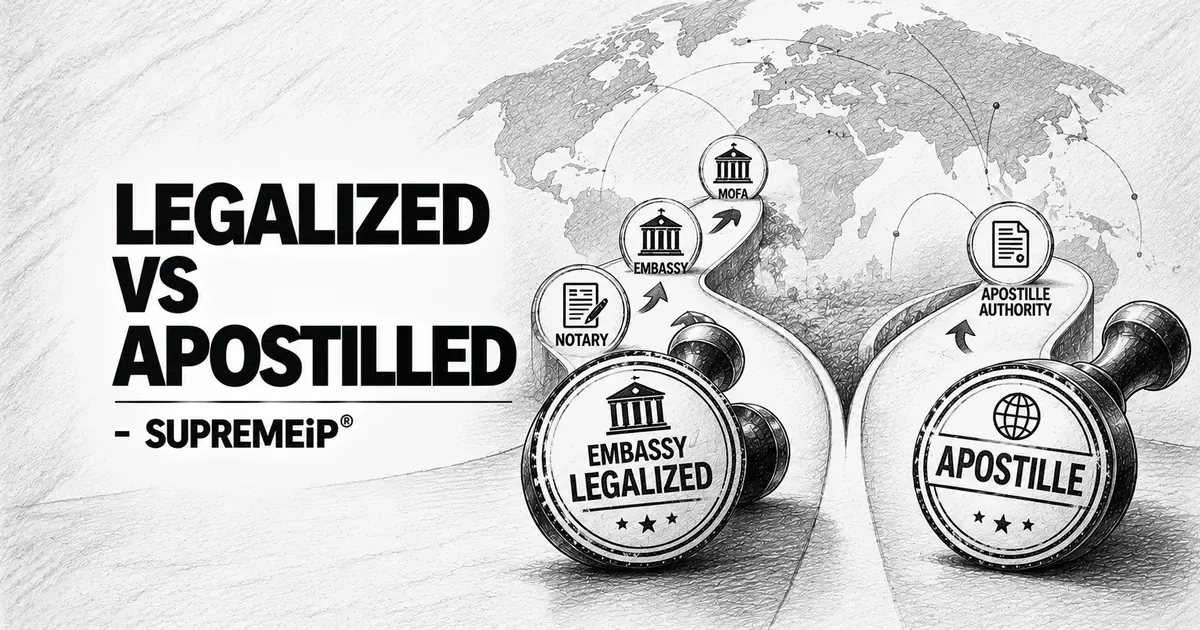
Notary, embassy and foreign ministry each confirm the one before. Used where the Hague Convention does not apply.
One competent authority attaches a standard certificate. Used between Hague member countries.
Both make a foreign document usable before DPDT, courts and registries in Bangladesh.
What Is Legalized? Legalization Explained
A legalized document has passed through a chain of official endorsements. Each office confirms the signature and seal of the office before it. The chain ends with the foreign ministry of the country where the document will be used.
Legalization is needed when the issuing country is not a Hague Apostille Convention member, or when the receiving country has objected to apostilles from the issuing country.
Legalization Process: Step-by-Step
Notarization or Certification
The document, for example a Power of Attorney or Assignment Deed, is notarized in the country where it is signed.
Bangladesh Embassy or Consulate
The notarized document is attested by the Embassy or High Commission of Bangladesh in that country.
Forward to a Local Agent
The attested original is sent to a lawyer or agent in Bangladesh for submission.
Submission to MoFA
The agent submits it to the Ministry of Foreign Affairs (MoFA) of Bangladesh.
Verification of the Attestation
MoFA checks the embassy seal against its records of authorized officers.
MoFA Seal Applied
MoFA applies its seal. The document is now ready for DPDT or a court.
What Is Apostille? Apostille Explained
An apostille is a standard certificate issued under the Hague Convention of 5 October 1961. One designated authority in the issuing country attaches it. No embassy step follows. Any other member country should accept the document as genuine.
Standard Certificate
Every apostille uses the same model, in the same layout, in every member country.
e-Apostille with QR Code
Some authorities issue electronic apostilles. The recipient can check them online.
Authenticates the Signature, Not the Content
An apostille confirms who signed and in what capacity. It does not confirm the document is true or valid for your purpose.
Bangladesh became a contracting party to the Apostille Convention on 30 March 2025. Apostilled foreign documents can now be used in Bangladesh, and Bangladeshi documents can be apostilled for use abroad.
Legalized vs Apostilled: Side-by-Side Comparison
This table shows the practical differences for IP filings in Bangladesh.
| Feature | Legalized | Apostilled |
|---|---|---|
| Applies between | Non-Hague countries, or where an objection exists | Hague member countries |
| Offices involved | Notary, embassy, foreign ministry | Notary and one competent authority |
| Embassy step | Required | Not required |
| Typical time | Longer. Often 3–6 weeks including courier | Shorter. Often 3–10 business days |
| Cost | Higher, with several fees | Lower, with fewer fees |
| Accepted in Bangladesh | Yes | Yes, since 30 March 2025 |
| Main risk | Delay | Objection by the other country |
Apostille Process: Foreign and Bangladeshi Documents
The steps depend on where the document is signed.
Foreign Documents for Use in Bangladesh
Notarize the Document
A notary public in the home country witnesses the signature.
Apply to the Competent Authority
Examples: the FCDO in the UK, the Ministry of External Affairs in India, or the Secretary of State or Department of State in the USA.
Receive the Apostille
The authority attaches the certificate, on paper or as an e-Apostille.
File in Bangladesh
Submit to DPDT or the court. No embassy or MoFA step is needed.
A UK company can apostille its Deed of Assignment and send it directly to DPDT. The embassy attestation step is no longer needed.
Bangladeshi Documents for Use Abroad
Notarize in Bangladesh
A notary public in Bangladesh witnesses the document.
Submit to MoFA
MoFA is the competent authority for apostilles in Bangladesh.
Receive the e-Apostille
MoFA issues a certificate the foreign recipient can verify online.
Use in a Member Country
The document is accepted without embassy attestation, unless the country has objected.
When Legalization Is Still Required
Apostille is not always available. Legalization remains the route in these cases.
Non-Hague Country
The issuing country is not a member of the Convention. Only legalization is possible.
Authority Instruction
DPDT or a court asks for embassy attestation for a specific document.
Formal Objection
A country has objected to the accession of Bangladesh. Apostilles do not work between the two.
Contested Ownership
Some disputed assignments may call for the fuller verification chain.
Countries That Have Objected to Bangladesh’s Accession
The following countries are reported to have objected. Documents between Bangladesh and these countries still need legalization. Always confirm the current position on the HCCH status table before you prepare documents.
Apostille and Legalization for Trademark, Patent & Design Filings
DPDT accepts apostilled and legalized documents for IP work. Bare notarization is generally not enough for a foreign document.
Trademark Documents
Assignments, Power of Attorney, affidavits, licence agreements and name or address change deeds.
Patent Documents
Assignments, inventor declarations, licence agreements and MOUs for filings under the Patents Act 2023.
Design Documents
Design assignments and ownership transfer documents for registration and recordal.
Documents Most Often Authenticated
| Document | Typical Use | Tip |
|---|---|---|
| Power of Attorney | Appoints a Bangladesh agent to file and act | A general POA can cover several filings if drafted wide enough |
| Deed of Assignment | Transfers a mark, patent or design | Match owner names exactly with the records |
| Affidavit or Declaration | Proof of use, ownership or inventorship | Sign before a notary in the same form that DPDT expects |
| Licence or MOU | Records a licence or agreement | Check whether recordal is required |
Apostille generally works in Bangladeshi courts as well. For IP enforcement, confirm with your counsel which form of authentication the relevant court expects.
Time and Cost: Legalization vs Apostille
Legalization costs more because it adds the embassy attestation, courier charges and MoFA processing. Apostille usually needs only the notary and one authority fee.
Weeks, Not Days
Often 3–6 weeks. International courier time is included in that range.
Days, Not Weeks
Often 3–10 business days, depending on the issuing country.
Timing depends on the issuing authority and courier. Start authentication as soon as the filing is decided, before any deadline is close.
Common Mistakes with Apostille and Legalization
Notarization Only
A notary stamp alone is not enough for most foreign documents filed at DPDT.
Skipping the Objection Check
An apostille from or to an objecting country will be refused.
Wrong Authority
Apostille must come from the competent authority of the issuing country, not from any office.
Late Start
Courier and processing time are easy to underestimate. Late authentication can miss a deadline.
Legalized or Apostilled: Which One Should You Use?
Both Countries Are Members
Both countries are Hague members, no objection exists, and speed and cost matter.
Apostille Is Not Available
The issuing country is not a member, an objection applies, or the authority asks for embassy attestation.
Conclusion
Legalized vs apostilled comes down to the country behind the document. Legalization is a chain of endorsements. Apostille is one certificate. Since 30 March 2025, Bangladesh accepts both, so many foreign owners can now save time and cost.
The key check is the objection list. If the other country has objected, legalization is still required. A short review before you sign anything avoids rejection at DPDT.
Frequently Asked Questions on Legalized vs Apostilled
Q01What is the difference between legalized and apostilled documents?
Legalized documents pass through a chain of notary, embassy and foreign ministry. Apostilled documents carry one standard certificate from a single competent authority. Bangladesh accepts both for IP filings.
Q02What is apostille in simple words?
An apostille is a standard certificate that proves a signature, seal or stamp on a public or notarized document is genuine. It is issued under the Hague Convention of 1961.
Q03What is a legalized document?
It is a document whose signature and seals were confirmed step by step by a notary, an embassy and a foreign ministry. It is used where apostille is not available.
Q04When did Bangladesh join the Apostille Convention?
Bangladesh became a contracting party on 30 March 2025.
Q05Does DPDT accept apostilled documents?
Yes. DPDT accepts apostilled Powers of Attorney, assignments, affidavits and similar documents for trademark, patent and design matters, unless an objection applies.
Q06Which IP documents need apostille or legalization?
Common ones are the Power of Attorney, Deed of Assignment, affidavits, declarations, licence agreements, MOUs, and name or address change deeds.
Q07Is a notarized document enough for DPDT?
Generally no. A foreign document also needs apostille or legalization after notarization.
Q08How long does each route take?
Legalization often takes 3–6 weeks. Apostille often takes 3–10 business days. Actual time depends on the country and courier.
Q09What is an e-Apostille?
It is an electronic apostille, usually with a QR code, that the recipient can verify online. MoFA issues e-Apostilles for Bangladeshi documents.
Q10Who issues apostilles in Bangladesh?
The Ministry of Foreign Affairs (MoFA) is the competent authority for Bangladeshi documents.
Q11Which countries have objected to the accession of Bangladesh?
Reported objections include Germany, France, the Netherlands, Denmark, Austria, Finland, Belgium, the Czech Republic, Estonia, Lithuania, Greece and Argentina. Confirm the current list on the HCCH status table.
Q12What if my country is not a Hague member?
Then legalization is the only route. The document goes through the notary, the Bangladesh embassy and MoFA.
Q13Do UK, US or Indian companies still need embassy attestation?
Usually no. These countries are Hague members, so an apostille from their competent authority is normally enough. Check for objections first.
Q14Can one apostilled Power of Attorney cover several filings?
Often yes, if it is drafted broadly enough to cover the trademark, patent and design matters. This avoids repeating authentication.
Q15Do earlier legalized documents remain valid?
Documents already accepted and recorded at DPDT are not affected by the accession. Confirm with your counsel for any pending matter.
Q16What happens if I file the wrong authentication?
DPDT may refuse the document and ask for a corrected one. This can delay the filing, so check the route before you start.
Q17Can I use apostille in Bangladeshi courts?
Generally yes. For litigation, confirm the form of authentication the specific court expects.
Q18How does SUPREMEiP® handle apostille and legalization for IP filings?
We advise on the correct route, draft the Power of Attorney and assignment deeds, review documents before filing, and file with DPDT. One review up front helps avoid rejection.
Trademark · Patent · Design · Document Authentication · DPDT Filings


