


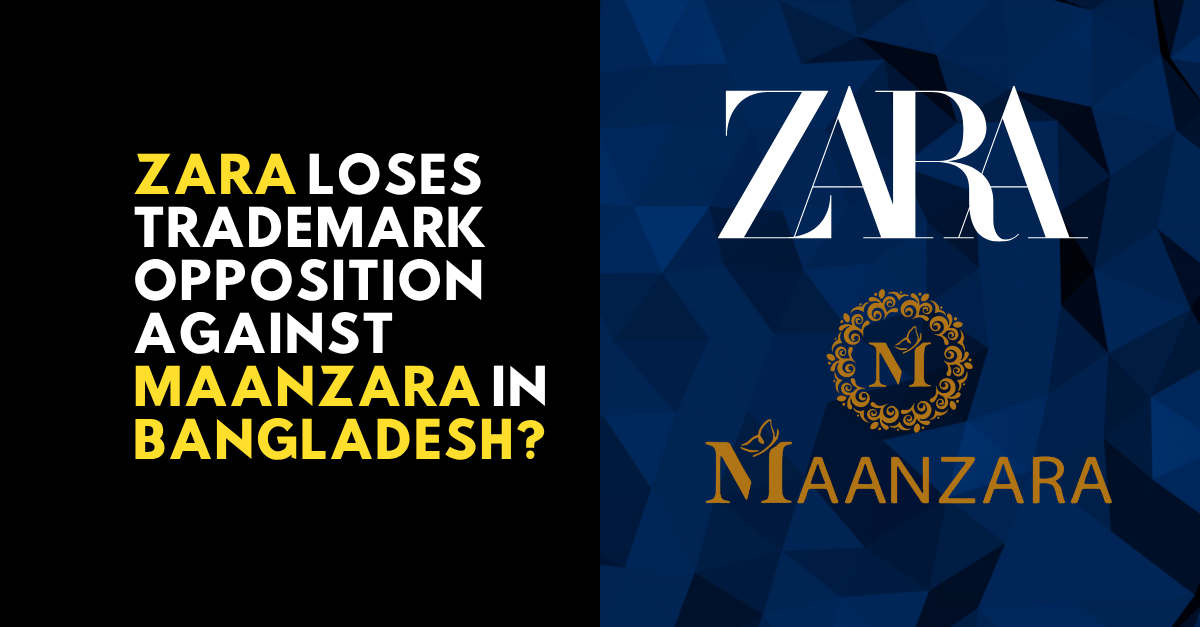
ZARA's Legal Setback: Losing the Opposition Case Against Maanzara in Bangladesh
A landmark trademark ruling by Bangladesh's DPDT — affirming Maanzara's right to its brand identity and dismissing ZARA's opposition in its entirety.
In a resounding triumph for local entrepreneurship and fair competition, Maanzara — the beloved Bangladeshi clothing brand — emerged victorious in a landmark trademark opposition case against global fashion giant ZARA. The ruling, handed down by Bangladesh's trademark authority, affirms Maanzara's rightful claim to its brand identity and sends a powerful message in support of indigenous businesses.
Case Overview
The dispute centered on Maanzara's application to register its trademark for Class 24 (clothing) in Bangladesh — a move aimed at solidifying its presence and protecting its brand in its home country. Despite having no operational footprint, no prior use, and no commercial presence in Bangladesh, ZARA filed an opposition alleging potential consumer confusion between the two brands.
Maanzara — a Bangladeshi clothing brand with genuine commercial presence and use in Bangladesh.
ZARA (Inditex Group, Spain) — global fashion giant with no operational footprint or prior use in Bangladesh.
DPDT Bangladesh — Department of Patents, Designs and Trademarks, Ministry of Industries.
Maanzara's Defense
Maanzara staunchly defended its right to its name. While acknowledging ZARA's global stature, Maanzara highlighted the fundamental differences between the two brands — in market presence, target demographics, and brand aesthetics.
"Maanzara is a single, distinctive coined word — visually, phonetically, and conceptually different from ZARA."
Different Market Presence
ZARA has no stores, sales, promotions, or any commercial activity in Bangladesh. Maanzara actively operates and serves the local Bangladeshi market.
Different Target Demographics
Maanzara's focus is on local Bangladeshi consumers with unique cultural sensibilities — entirely distinct from ZARA's global mass-market appeal.
Distinctive Brand Identity
"Maanzara" is a unique, coined word. It is visually, phonetically, and conceptually different from "ZARA" — no likelihood of confusion exists.
Why ZARA's Opposition Failed — Key Reasons
Although ZARA holds trademark registrations in Bangladesh, many of those registrations were not properly renewed or maintained at the time of the opposition, critically weakening their legal standing before the authority.
ZARA falsely suggested continuous and active protection of its mark in Bangladesh, despite clear gaps in renewal and compliance records — a misrepresentation that the authority took seriously.
ZARA had no commercial presence, no sales, no promotions, and no market activities within Bangladesh. The claim of prior use was entirely unsubstantiated and unsupported by evidence.
The opposition notice itself was weakly drafted and failed to establish any credible likelihood of confusion between "ZARA" and "Maanzara" — a fundamental legal requirement for a successful opposition.
In contrast, Maanzara successfully demonstrated active and genuine commercial use of its mark in Bangladesh — a decisive factor that firmly established its superior right to the trademark.
The authority found that "Maanzara" is a single, distinctive coined word — visually, phonetically, and conceptually different from "ZARA." These combined differences meant no reasonable likelihood of confusion could exist.
Verdict
These combined deficiencies led the authority to hold that ZARA's opposition entirely lacked merit — resulting in a clear and unqualified victory for Maanzara and its right to register its trademark in Bangladesh.
Broader Implications for IP Law in Bangladesh
Beyond the courtroom, this case has significant implications for Bangladesh's evolving intellectual property landscape. It underscores the importance of protecting local brands against undue challenges from global players and upholds the integrity of IP rights.
Protection of Local Brands
Global brands cannot oppose local trademark registrations without genuine commercial presence, prior use, or credible evidence of confusion in the local market.
Importance of Trademark Maintenance
Even global brands must keep their Bangladesh registrations properly renewed and maintained — failure to do so weakens their legal position significantly.
Support for Indigenous Innovation
The ruling affirms Bangladesh's commitment to fair competition and the protection of homegrown businesses in its own IP landscape.
Legal Representation
Mr. J. A. Chaudhury Reagan
Advocate, Supreme Court of Bangladesh
Partner, SUPREMEiP Law Firm
Md. Masum Rahman
Advance IP Law Firm
Conclusion
Maanzara's victory in this trademark opposition case against ZARA represents a significant milestone for local businesses in Bangladesh and a reaffirmation of the principles of fairness and justice in IP law. As Maanzara continues to thrive, it stands as a shining example of homegrown excellence and the strength of a well-prepared legal defense.
SUPREMEiP Law Firm
Expert trademark registration, opposition, and enforcement across Bangladesh — DPDT proceedings handled with precision.


